

The Learn-Do-Explain-Repeat method
The 12 tips fall into four stages. Most freshers spend all their time on the first stage and skip the other three. That is where interviews are lost.
- Learn (tips 1 to 4): turn every topic into interview questions and short answers.
- Do (tips 5 and 6): build real work you can show.
- Explain (tips 7 to 11): say your answers out loud, in clear English, with feedback.
- Repeat (tip 12): give many interviews and learn from each one.
Everyone studies. Few people explain. The candidate who can explain a small project clearly usually beats the candidate who memorized 200 answers.
Why knowing the concepts is not enough
If you are a fresher, you may be thinking: “Most companies offer freshers only ₹10,000 to ₹15,000 a month. How do I get a better offer?”
You are partly right. In my experience, many companies do start freshers on a lower salary, and the range changes with city, company size and role. But your offer is not decided by your qualification alone. It also depends on how confidently you can:
- handle a project on your own
- solve real problems, like a traffic drop, a high cost per lead or low engagement
- explain your ideas and the reasoning behind them
- show how you will contribute to the company
Your experience does not have to come from a previous job. Websites you optimised, ad campaigns you ran with a small budget, content you published, social pages you grew or audits you performed during training all count. What matters is that you can explain what you did and why.
This matches how Google describes trustworthy content too: first-hand experience and clear reasoning build trust. You can read Google’s own guidance on helpful, reliable, people-first content, and the same idea works in an interview room.
The skill most beginners overlook: communication
Companies are not only looking for someone who understands SEO, Google Ads or Meta Ads. They want someone who can explain their work to clients, ask the right questions and handle conversations professionally, often in English.
So do not just memorise interview questions. Aim to become someone who can:
- understand the concepts of your role
- apply them in practice
- explain your work clearly
- communicate confidently
- handle a project independently
These tips work for every digital marketing role: SEO executive, PPC or performance marketing executive, content writer or content marketer, social media executive, email marketer, and newer roles in GEO (generative engine optimisation) and AEO (answer engine optimisation).
If those two newer terms are unfamiliar to you, then start with my posts on GEO vs SEO and AEO vs SEO, then read Google’s own guide on optimizing for generative AI search.
12 proven ways to prepare for a digital marketing interview
Stage 1: Learn
1. Turn every class into 5 to 10 interview questions
After each class, list the questions an interviewer could ask about that topic. Many trainers do this at the end of a topic. If yours does not, or you are learning on your own, ask ChatGPT, Gemini or Claude.
Use a prompt like this:
Give me 10 interview questions commonly asked about [topic] for a [role] fresher. Answer each in the simplest possible way, in 1 to 2 sentences.
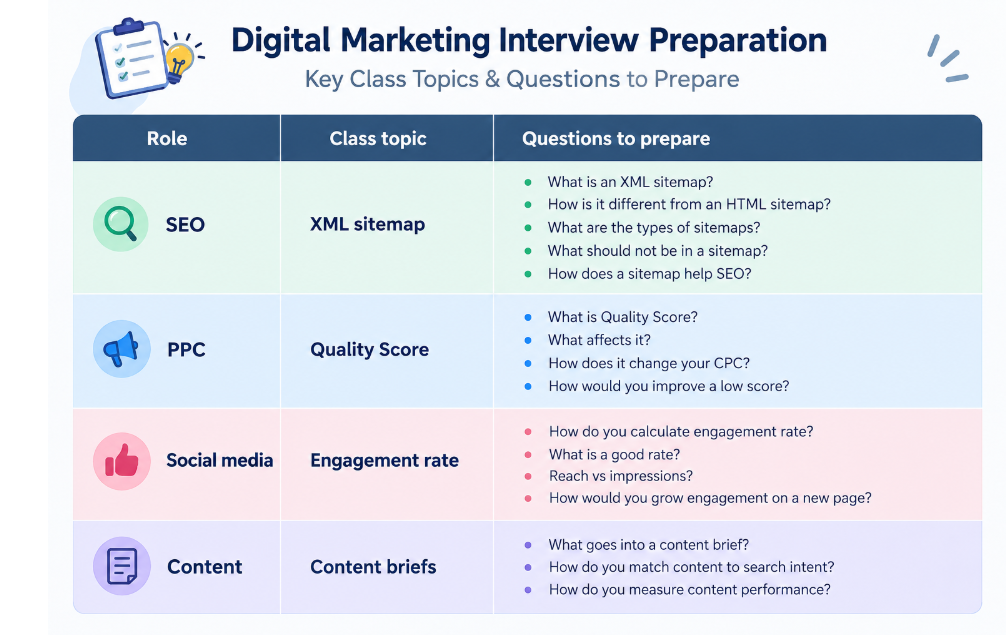
Short answers are easier to remember and easier to say quickly in an interview. Here is how it looks for four different roles:
| Role | Sample interview question | Short answer you can say in one breath |
| SEO | What is an XML sitemap? | A file that lists the important URLs of your website so search engines can find and crawl them. See how a sitemap helps search engines. |
| PPC | What is Quality Score? | Google’s 1 to 10 estimate of ad quality, based on expected click-through rate, ad relevance and landing page experience. |
| Social media | What is engagement rate? | Interactions such as likes, comments, shares and saves divided by reach or followers, multiplied by 100. Always say which base you used. |
| Content marketing | What is a content brief? | A one-page guide for the writer with the target keyword, search intent, audience, outline, word count, internal links and tone. |
For any “how do you create…” question, do not just learn the answer. Do the task once so you can explain it from experience.
For SEO roles, you can practise real questions in my guides on on-page SEO interview questions, technical SEO interview questions, off-page SEO interview questions and local SEO interview questions. Start with keyword research and types of keywords, because almost every interview starts there.
2. Write your answers, do not just read them
Reading feels productive, but it fools you. You nod along, and then you cannot say the answer when someone asks. Writing forces you to find the gaps.
Keep a notebook or a Google Doc with all your questions and answers. Writing helps you understand the topic, spot weak areas and remember answers for much longer. It also becomes a ready revision sheet the night before an interview.
What does not work: copying a list of “top 100 questions” from a PDF and reading it twice. Interviewers can tell within two follow-up questions. What works: writing answers in your own words and adding one example from your own practice work.
3. Take online quizzes for your role
Many websites offer free quizzes on SEO, PPC, content marketing, social media marketing, analytics, GEO and AEO. They range from 20 to 500 questions, and many are role-specific.
Pick quizzes that match the job you want. Quizzes help you:
- see different types and styles of questions
- check your score in real time
- read short explanations of the correct answers
Take 2 to 3 quizzes and repeat them until your score is consistently good. Note every question you got wrong and study that topic again. You can start with my free Digital Marketing Quiz and SEO Quiz.
Free certification exams are also good practice, and the certificates add value to your resume. Google Skillshop offers free Google Ads and analytics learning paths.
A quiz tests recall. An interview tests judgement. Use quizzes to find weak topics, then fix those topics with real practice, not with more quizzes.
4. Build questions from real job descriptions
Job descriptions often read as if the company wants a superhero with 360-degree marketing knowledge, even for an SEO executive or a social media executive role.
There is a reason for that. You cannot do well in any digital marketing role without understanding the target audience, search intent, business goals, buyer personas and marketing funnels.
Search Google, LinkedIn or Naukri for jobs in your role. Copy 3 to 5 job descriptions into ChatGPT or Claude and ask:
Based on this job description, give me the 15 most likely interview questions with short answers for a fresher.
This prepares you for what that type of company actually wants. If you are still choosing a direction, read how to start a career in digital marketing and how to get a digital marketing job without a degree.
Stage 2: Do
5. Do real hands-on work for your role
Practical work makes interviews much easier. When you know how to do something and why you did it, explaining it comes naturally. It also gives you a portfolio to show.
| Role | Practice project |
| SEO | Build a WordPress site for a niche like a dental clinic or plumbing service on free hosting (for example InfinityFree with a free subdomain). Create pages, write meta titles and descriptions, optimise with Rank Math or Yoast, add alt text, create a sitemap and submit it in Google Search Console. |
| PPC / performance marketing | Run a small-budget Google Ads or Meta Ads campaign for your practice site or a friend’s business. Set up keywords, ad groups, ad copy and conversion tracking, then report on CTR, CPC and conversions. |
| Social media | Create and manage a page for a niche for 30 days. Plan a content calendar, design posts in Canva, post Reels, and track reach and engagement. |
| Content marketing | Write 3 to 5 blog posts for your practice site. Include keyword research, a content brief, internal links and on-page optimisation. |
| Email marketing | Build a free Mailchimp or Brevo account, create a welcome sequence and track open and click rates. |
When you are done, use ChatGPT or Claude as your manager. Share your complete work and ask for a review. It will point out what is missing and what you can improve, which is the kind of feedback a real manager gives. Tracking results matters too, so learn to set up Google Analytics 4 on a new website.
No experience yet? My guide on how to get work experience for a job and the post on how a blog can help you get a digital marketing job show more ways to build proof.
6. Watch process tutorials
Every role has processes: an SEO audit, a technical SEO fix, a link-building campaign, a Google Ads account setup, a Meta Ads funnel, a content calendar.
Watch step-by-step tutorials on these and follow along. This deepens your understanding and helps you explain the process clearly when an interviewer asks, “How would you do this?” For SEO roles, Google’s free SEO Starter Guide is a good first tutorial to follow.
Watching alone is not enough. Pause the video, repeat the steps on your own practice site, and then explain the process aloud without looking at the screen.
Stage 3: Explain
7. Practise with AI interview tools
AI tools can now act as your interviewer. Depending on what you want to practise, you can use:
- chat-based mock interviews with ChatGPT, Gemini or Claude (ask it to interview you for your role, one question at a time, and grade each answer)
- voice mode, to practise speaking answers out loud
- AI interview platforms with avatar-based or video interviews
- quiz generators for objective-type questions
These tools are available anytime, so you can practise daily. One caution: AI feedback is only as good as your instructions. Tell it your role, your experience level and the company type, and ask it to point out weak answers instead of praising every answer. If you want to explore more tools, see my list of free AI tools for non-tech users.
8. Record yourself answering questions
Speak your answers in front of a camera and watch the recording. Most people feel nervous on camera at first and do not speak as naturally as they normally would. That is exactly why it is good practice.
Recording helps you become more fluent and confident. It also builds a valuable marketing skill: creating video content. Social media and content roles especially value this.
9. Test and improve your English
Many larger companies and agencies test your English writing, speaking and listening, especially for client-facing roles. Some use online tests such as EF SET, which is free and gives a certificate, or British Council assessments, and only invite candidates with good scores to the next round.
Start practising on these apps from the first week of your course. They help you communicate better, and many offer a certificate you can add to your resume and LinkedIn. For daily habits, read how to improve your communication skills at work.
10. Ask your trainer for a mock interview
A mock interview is a rehearsal for the real one. Do at least one before or soon after you finish your course.
If your institute does not run mock interviews, ask your trainer to take one, or ask a working professional in your field. Request honest feedback on both your answers and your body language, then practise the weak areas. A friend who only says “it was good” is not helping you.
11. Watch mock interviews on YouTube
Many institutes, agencies and creators publish mock interviews and real-case discussions for SEO, PPC, social media and content roles.
These videos show you the interview room: how questions are asked, how candidates answer and where they struggle. While watching, pause after each question and answer it yourself before the candidate does.
You will also notice that other candidates get nervous too. That is reassuring. You are not the only one who feels underconfident, and it gets better with practice.
Stage 4: Repeat
12. Give as many interviews as you can
This is the most important tip. The more interviews you give, and yes, the more rejections you face, the better you get.
As a fresher, set aside 15 days to a month to apply widely. Apply for roles you are interested in, such as SEO, PPC, content writing or social media. A strong resume helps, so check what to include in a resume before you apply.
After each interview, write down every question you were asked. Work on the ones you could not answer well. With each interview, you will gain confidence and experience.
If you have just finished your course and are unsure what comes next, read what to do after a digital marketing course.
What the hiring process usually looks like
Most digital marketing agencies and companies hire in 2 to 3 rounds. The names vary, but the pattern is similar across SEO, PPC, content and social media roles.
| Round | Who takes it | What they check | How to prepare |
| 1. Screening | HR or team lead | Communication, personality, basic concepts, interest in the role | Practice “Tell me about yourself”, know the company, revise basics |
| 2. Technical | Manager or senior specialist | Core and in-depth knowledge, practical skills; sometimes a live task or assignment (an audit, ad copy, a content piece, a social media plan) | Revise your notes, keep your practice projects ready to show and explain |
| 3. Final | MD, founder or HR | Fit with the team, salary negotiation, role and joining details | Research typical salaries for the role, be clear on what you expect and why |
Interviews can be in person or remote, so prepare for both. For online interviews, test your camera, microphone and internet beforehand, and keep a quiet, well-lit space. Keep your portfolio links ready to share on screen.
Your interview preparation checklist
Use this checklist alongside your course, whatever role you are preparing for.
During your course
- Write 5 to 10 interview questions and short answers after every class
- Keep all answers in one notebook or Google Doc
- Practise English on an app for 15 minutes a day
- Complete at least one hands-on practice project for your role
Last month of your course
- Take 2 to 3 role-specific quizzes or free certifications
- Watch at least 5 mock interviews for your role
- Create questions from 3 to 5 real job descriptions
- Record yourself answering 10 common questions
- Get your practice work reviewed by AI and your trainer
- Do a mock interview with your trainer
Before each interview
- Research the company, its clients and its own website or social pages
- Prepare your “Tell me about yourself” answer
- Keep your resume, portfolio and certificates ready
- Test your setup if the interview is online
After each interview
- Write down every question you were asked
- Prepare better answers for the ones you missed
Take Action:
Do not try all 12 tips at once. This week, pick one: take the Digital Marketing Quiz, note your wrong answers, and write a short answer for each one. Then book one mock interview with your trainer or a working professional.
Cracking a digital marketing interview is not about memorizing answers. It is about understanding your role, doing real work, explaining it clearly and communicating with confidence. Start early, practice a little every day and treat every interview as a lesson. All the best for your interviews.
Frequently asked questions
How do I prepare for a digital marketing interview as a fresher?
Start from the first day of your course. Write interview questions and answers after every class, do hands-on projects for your role, take quizzes, practice mock interviews and work on your English communication.
Are these tips only for SEO interviews?
No. They work for SEO, PPC, performance marketing, content marketing, social media, email marketing, GEO and AEO roles. Only the topics and practice projects change by role.
How long does it take to prepare for a digital marketing interview?
If you prepare alongside your course, you will be ready by the time it ends. If you are starting fresh, plan for 4 to 6 weeks of focused practice, plus 2 to 4 weeks of applying and giving interviews.
Can I get a digital marketing job without experience?
Yes. Practice projects count as experience if you can explain what you did and why. A small website, a test ad campaign, a social page you grew or a set of blog posts can all go in your portfolio.
How do I get a better salary as a fresher?
Show practical skills, a portfolio, certifications and confident communication. Candidates who can handle a project independently often get better offers than those with only theory.
Which AI tools help with interview preparation?
ChatGPT, Gemini and Claude can generate role-specific questions, run mock interviews, review your practice work and give feedback on your answers.
What should I say when the interviewer asks, “Tell me about yourself”?
Keep it to about 60 seconds: who you are, what you studied or trained in, one practice project you completed and what you want to do next in the role. End with why this company interests you.


