AI Mode is Google’s conversational search experience, powered by Gemini. It lets you to ask complex, multi-part questions and get written, synthesized answers directly in Search.
You can also ask follow-up questions in a chat-like format. In other words, AI Mode works alongside AI Overviews, which provide summarized answers above traditional blue links for many searches.
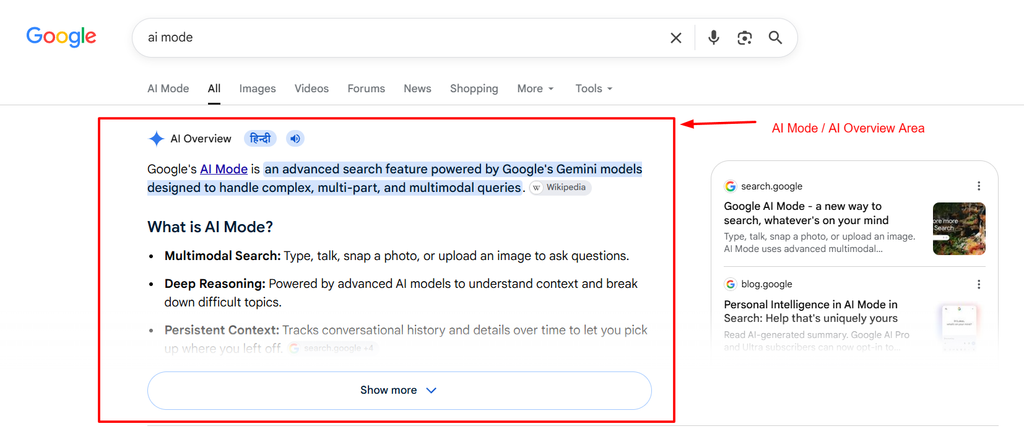
For an SEO student, the key idea is simple: AI Mode is not a separate search engine. It is Google using AI to present search results in a different way.
It still uses Google’s web index, crawling, and ranking systems the same foundation that traditional SEO has always focused on.
Even Google officially confirms that no special or extra SEO steps are required to appear in AI search features.
Every few years, Google changes the way people search. We’ve seen mobile search, voice search, featured snippets, and now AI Mode. Each change creates the same question: “Does SEO still matter?”
But that’s the wrong question. The real question is: “How do we make our content discoverable when Google keeps changing how it shows answers?”
Remember, SEO was never just about ranking blue links. It was about creating content that Google can find, understand, trust, and show to users.
AI Mode changes how Google presents the answer, but the basic SEO principles remain the same. Your content still needs to be crawled, understood, trusted, and selected by Google.
What AI Mode Actually Changes
- Zero-click searches are increasing. People are getting answers directly in Google’s AI-generated results, so they don’t always need to visit a website. This is especially common for informational, definition, and comparison searches.
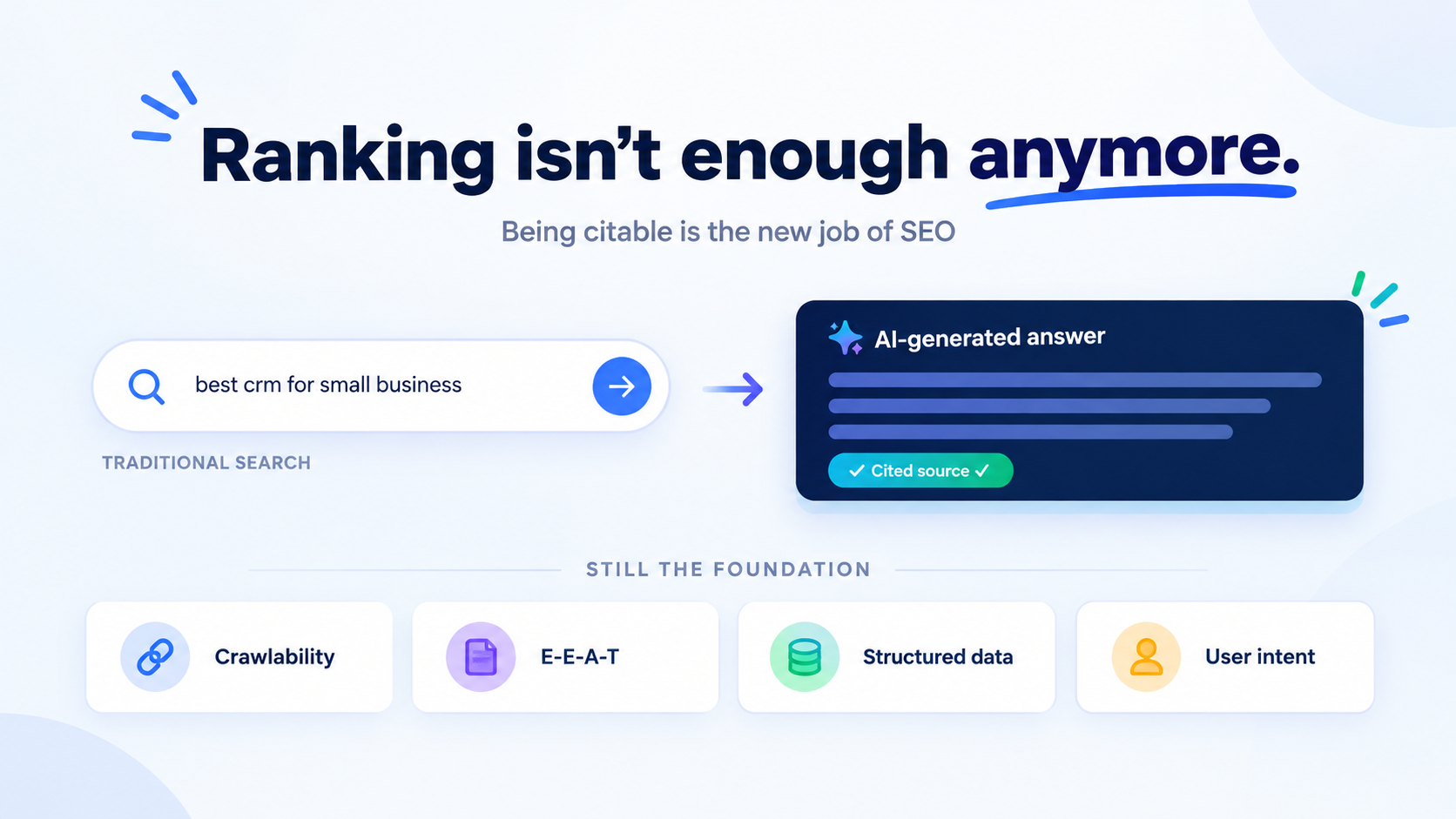
- Being cited can matter as much as ranking #1. Instead of only trying to reach the top position, websites now also want to become one of the trusted sources that AI uses and cites in its answer.
- Searches are becoming more conversational. People are asking longer, more detailed questions instead of using short keyword phrases like they often did in traditional SEO.
- Clear and well-structured content matters more. AI needs to understand, extract, and summarize information from a page. So content that is clear, organized, and easy to understand has an advantage.
These are real changes in search impacting in more impressions but less CTR. They change how we do SEO but they don’t make SEO irrelevant.
What AI Mode Doesn’t Change
This is the part many “SEO is dead” discussions miss. AI is changing how people search, but the fundamentals of SEO are still important:
- Google still needs to crawl and index your website. If Google can’t access or understand your page, it can’t show it in traditional search results or use it as a source for AI answers. Technical SEO fundamentals like crawlability, site speed, mobile usability, and structured data still matter.
- Trust and expertise still matter. AI needs reliable information to create its answers. Websites that demonstrate experience, expertise, authority, and trust (E-E-A-T) can have a stronger chance of being used as sources.
- People still click when they want to take action. For searches like “digital marketing course near me” or “best CRM for small business pricing,” users often need to compare options, visit websites, check details, and make a decision. AI can help with research, but it doesn’t completely replace that process.
- Backlinks and website authority still matter. Links from relevant, trustworthy websites can continue to act as signals of credibility and authority, both for traditional search and for being considered a useful source by AI systems.
AI Mode changes how SEO works at the surface level. It doesn’t remove the fundamentals: crawlable websites, useful content, expertise, trust, authority, and satisfying user intent still matter.
Traditional SEO vs GEO
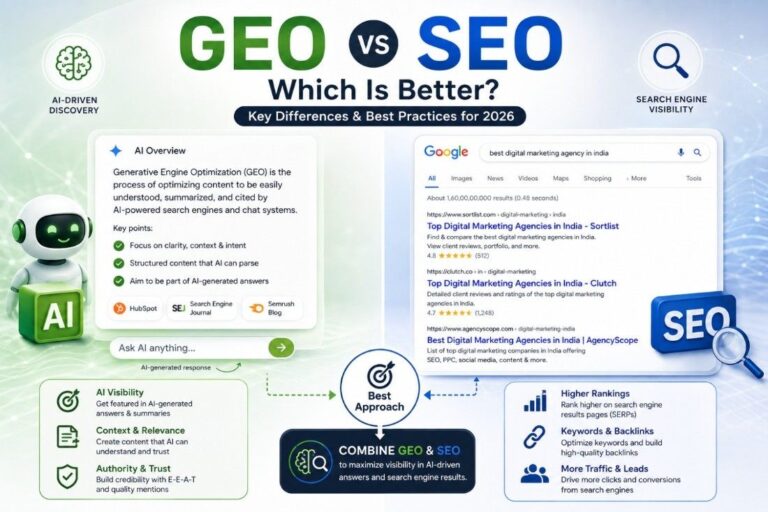
GEO (Generative Engine Optimization) has emerged as the term for optimizing specifically for AI-generated answers. It’s useful to see where it overlaps with traditional SEO and where it genuinely diverges.
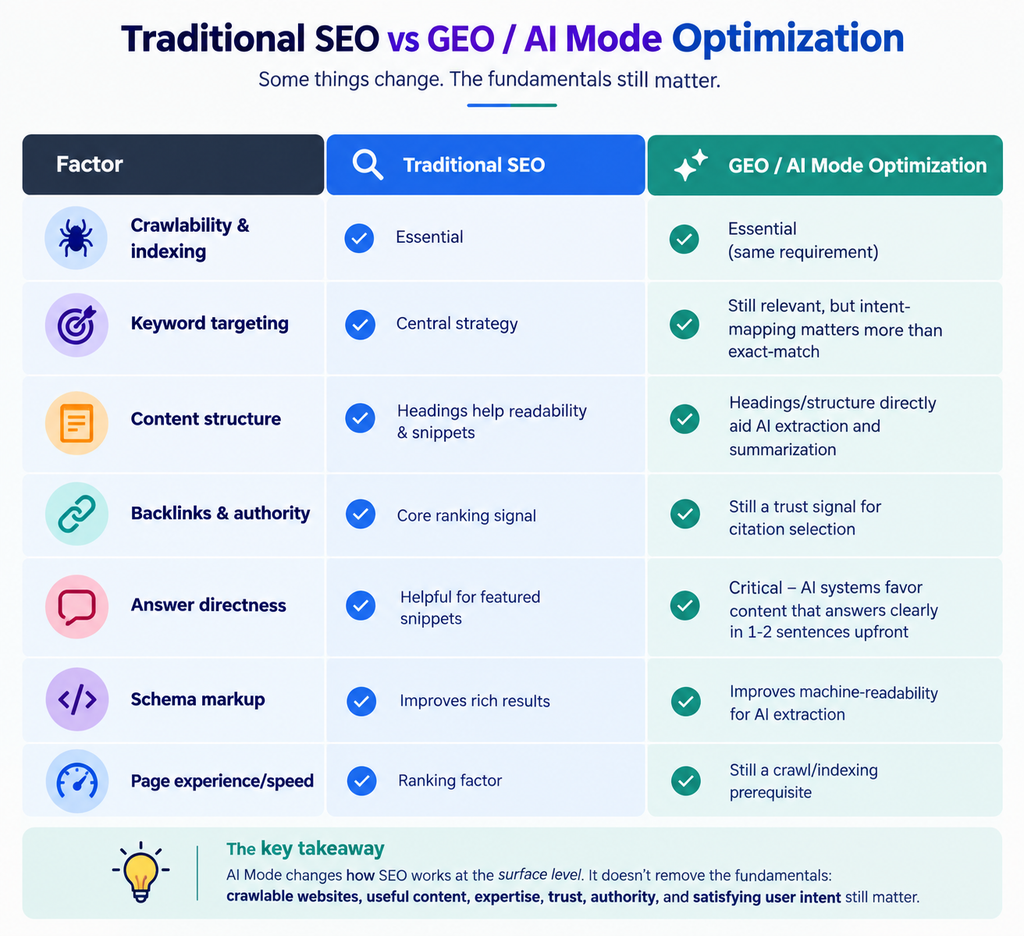
What should be the SEO approach further for Professional and beginners:
1. Prioritize being citable, not just rankable.
Write direct, extractable answers in the first 1 – 2 sentences of a section, the way this article’s FAQ section is structured.
Ahrefs’ most recent update, using December 2025 data across 300,000 keywords, found position-one organic CTR drops by 58% when an AI Overview appears on the SERP up sharply from the 34.5% drop it measured in early 2025.
Separately, Seer Interactive found that being cited inside an AI Overview delivers roughly 35% more organic clicks than not being cited on the same query so citation isn’t just visibility, it’s a measurable click premium.
Sources:
Ahrefs: AI Overviews Reduce Clicks
Search Engine Land: New data on AI Overviews and CTR
2. Double down on E-E-A-T signals.
Author credentials, original data, first-hand experience, and transparent sourcing matter more when a machine is deciding what to trust and cite. This tracks with Google’s own public documentation on how it defines quality and trust signals for ranking systems.
3. Don’t abandon technical SEO.
Site speed, crawl efficiency, and structured data remain the gate everything else passes through a page that isn’t crawled or rendered correctly can’t be cited, regardless of content quality.
4. Track AI Overview visibility as its own metric, separate from traditional rank tracking
Since it’s a different kind of visibility with different competitive dynamics. This is now standard practice: Google Analytics added a native AI-referral channel grouping in 2026 specifically because AI-driven traffic behaves differently from classic organic sessions, and third-party platforms (Ahrefs Brand Radar, Profound, Semrush) now offer dedicated citation-tracking separate from rank trackers.
AI Mode is changing how Google delivers answers, but it isn’t making SEO obsolete.
The fundamentals crawlability, helpful content, E-E-A-T, authority, and search intent still determine whether your content can be discovered and trusted.
What’s changing is the goal: SEO professionals must optimize not only to rank, but also to be understood, selected, and cited by AI. The future of SEO isn’t SEO vs. GEO it’s building content that performs across both traditional search and AI-powered experiences.
Frequently Aasked Questions
Is traditional SEO becoming obsolete because of AI Mode?
No. AI Mode still depends on search engines’ underlying crawling, indexing, and retrieval systems. Traditional technical SEO therefore remains essential for making content discoverable and is still a prerequisite for earning visibility or citations in AI-generated answers.
What is the difference between SEO and GEO (Generative Engine Optimization)?
GEO focuses on improving a brand’s visibility within AI-generated answers, with greater emphasis on clear, extractable answers, content structure, topical authority, and E-E-A-T. It complements traditional SEO rather than replacing its technical and foundational principles.
Will AI Mode reduce website traffic?
For some informational queries, it can. AI-generated answers increasingly satisfy users without requiring a click, which can reduce organic click-through rates for certain types of content. Commercial, transactional, and local searches may be more resilient because users often need to compare options, evaluate providers, or take action on a website.
Do backlinks still matter after AI Mode?
Yes. Backlinks remain an important signal of authority and relevance in traditional search, and a strong backlink profile can also support the credibility and visibility of content that AI systems may consider for citation. However, backlinks are only one part of a broader authority and content-quality picture.
Should businesses stop investing in SEO because of AI search?
No. Businesses should adapt their SEO strategy to account for AI-driven search rather than abandon SEO altogether. That means continuing to invest in technical foundations and authority while also creating structured, authoritative, easy-to-cite content that can perform well across both traditional and AI-powered search experiences.
How can I tell if my content is being cited in AI Overviews?
Some SEO and rank-tracking platforms now provide dedicated AI Overview and AI search visibility metrics alongside traditional keyword rankings. Google is also expanding the search-performance data available to site owners, although the level of AI-specific reporting can vary by feature and platform.
Does keyword research still matter for AI search?
Yes, but the focus is shifting from targeting individual exact-match keywords to understanding broader search intent. AI Mode is designed to handle longer, conversational, and multi-part queries, so effective keyword research should increasingly map the questions, needs, and decision-making journeys behind those searches.