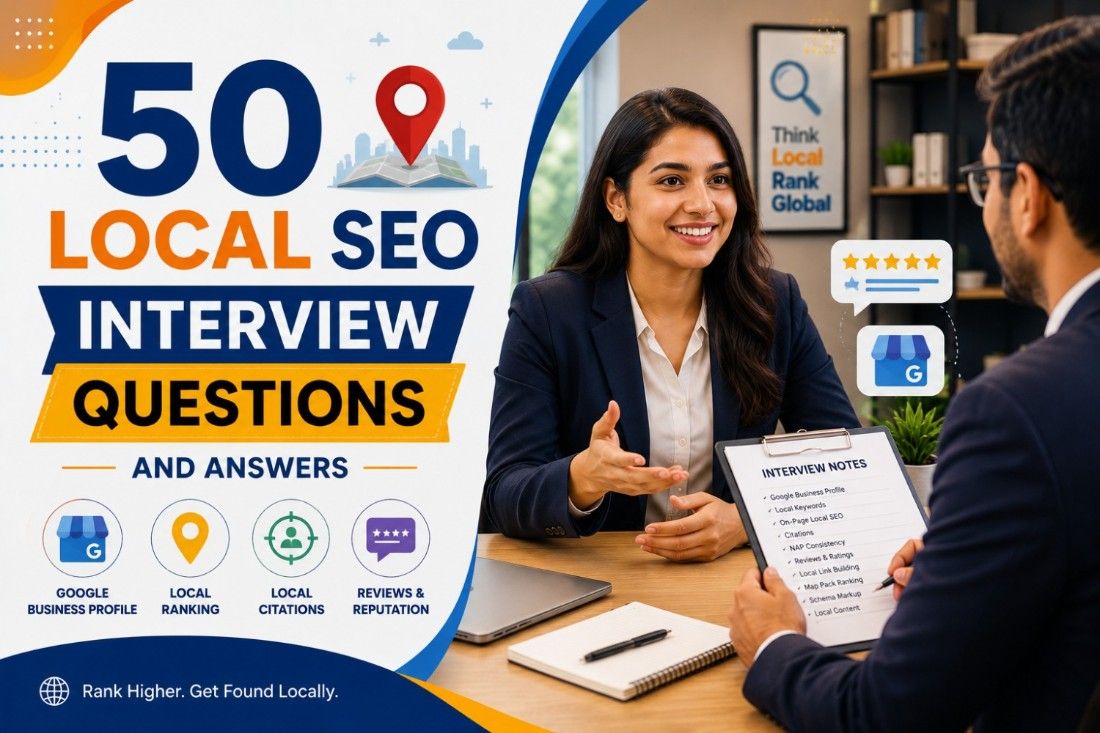
Local SEO is a specialized area tested heavily in interviews for agencies, multi-location brands, and small-business-focused marketing roles. Interviewers want to see that you understand not just Google Business Profile basics, but also citations, reviews, local ranking factors, and how local search actually differs from broader organic SEO.
This blog covers the Top 50 Local SEO interview questions and answers, from foundational concepts to advanced multi-location strategies. Every answer includes a short, practical example, and several include an Interview Tip to help you avoid common oversimplifications.
Local SEO Interview Questions Table of Contents
- Local SEO Basics
- Google Business Profile Questions
- Citations, NAP & Reviews
- Local Content & On-Page Questions
- Advanced & Multi-Location Local SEO
1. Local SEO Basics
1. What is Local SEO?
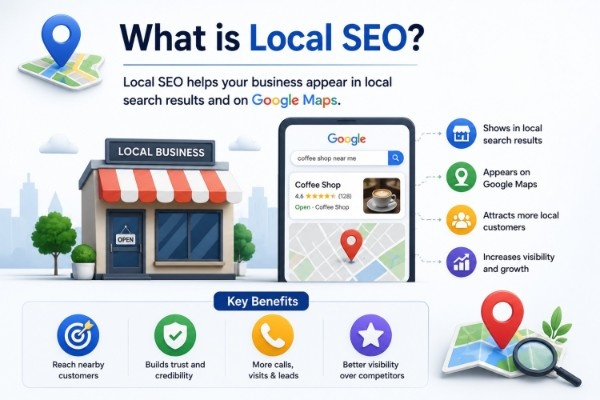
Answer: Local SEO refers to optimizing a business’s online presence to improve visibility in location-based searches, such as those with local intent or shown in Google’s map-based results.
Example: A dentist optimizing their online presence to appear when someone searches dentist near me.
2. How is Local SEO different from traditional organic SEO?
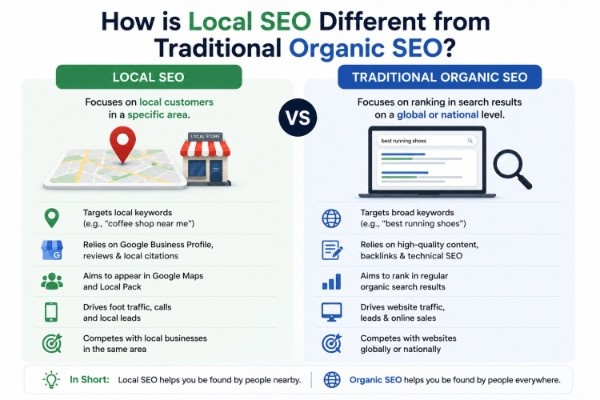
Answer: Local SEO focuses on location-based visibility and factors like Google Business Profile, citations, and reviews, while traditional organic SEO focuses more broadly on website content, backlinks, and technical health for non-location-specific queries.
Example: Ranking in the local map pack for plumber in Delhi versus ranking organically for how to fix a leaking pipe.
3. What is the Local Pack (Map Pack)?
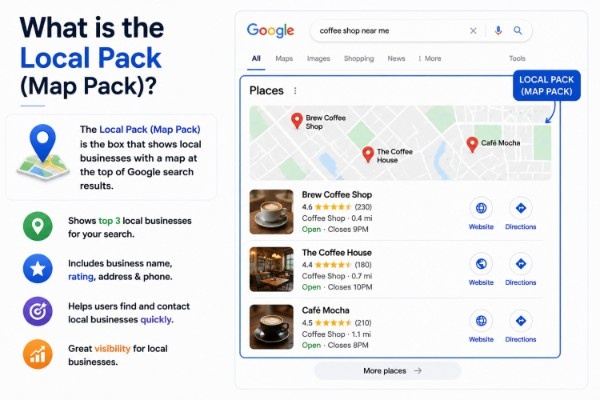
Answer: The Local Pack is a set of business listings, typically shown with a map, that appears for searches with local intent, usually featuring a small number of prominent local results.
Example: Searching “coffee shop near me” and seeing a map with three highlighted local coffee shops.
4. What are the three main factors Google considers for local ranking?
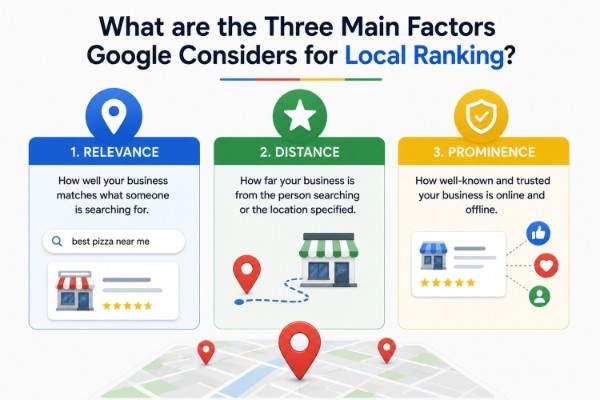
Answer: Google has described relevance, distance, and prominence as key factors influencing local search results, though the exact weighting isn’t publicly disclosed and can vary by query.
Example: A highly relevant, well-reviewed bakery slightly farther away may still outrank a closer but less established one.
Interview Tip: Remember the three local ranking factors in the correct order: Relevance, Distance, and Prominence. Interviewers often ask follow-up questions about each factor, so be prepared to explain them with examples.
5. What is Near Me search behavior?
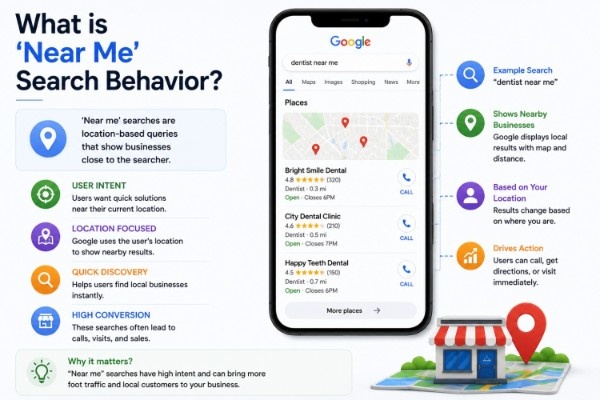
Answer: Near me searches reflect a user’s intent to find local results based on their current location, even when the phrase “near me” isn’t explicitly typed, since search engines can infer local intent from context.
Example: Someone searching just pizza while on their phone may still receive local pizza results relevant to their area.
6. What is proximity as a local ranking factor?
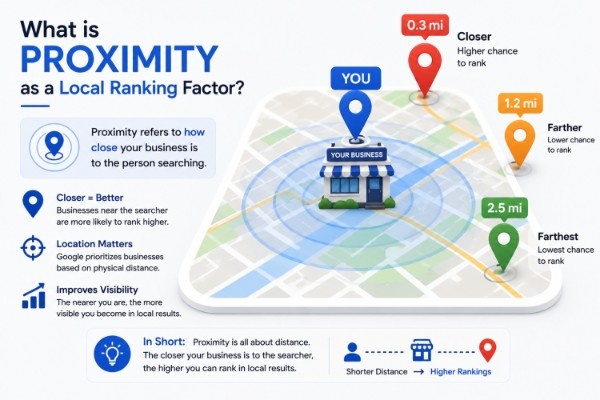
Answer: Proximity refers to how close a searcher (or the location specified in their search) is to a business, which can influence which businesses appear in local results.
Example: A user searching for coffee shop near me from Connaught Place, Delhi is more likely to see nearby coffee shops in that area than similar businesses located several kilometers away, even if those businesses have more reviews.
7. What is prominence in local SEO?
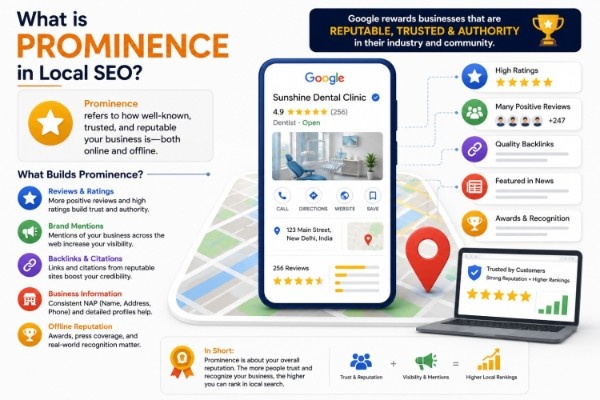
Answer: Prominence reflects how well-known or well-regarded a business is, based on signals like reviews, links, articles, and general online presence and reputation.
Example: A long-established, frequently mentioned restaurant may be considered more prominent than a newly opened one with no online presence.
8. What is a Service Area Business (SAB)?
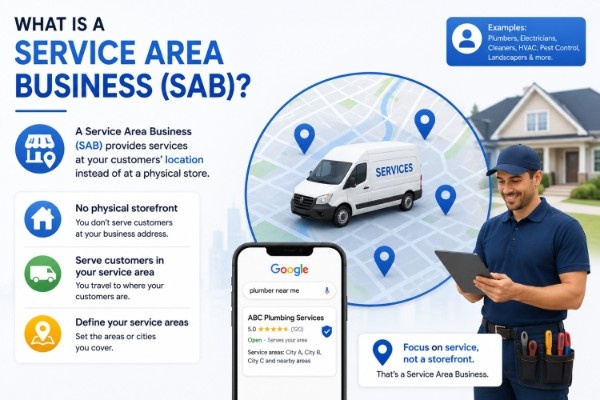
Answer: A Service Area Business is a business that serves customers at their locations rather than a fixed storefront, such as plumbers or mobile repair services, requiring specific handling in Google Business Profile setup.
Example: A mobile car detailing service that travels to customers rather than operating from a physical shop customers visit.
9. What is local search intent?
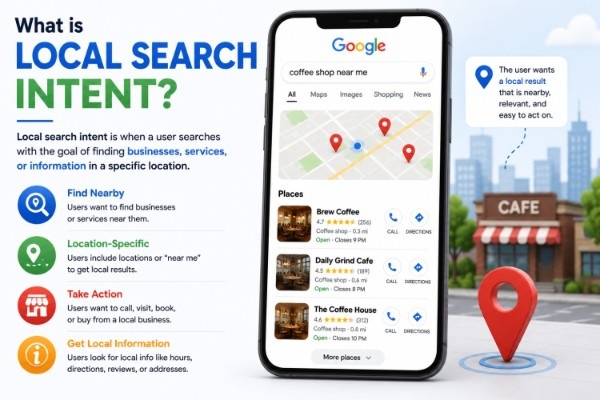
Answer: Local search intent refers to queries where the user is likely looking for a business, service, or place tied to a specific geographic area, whether explicitly stated or inferred from context and device location.
Example: Emergency electrician typed on a mobile device likely carries local intent, even without a location mentioned.
10. Why is Local SEO important for small businesses?
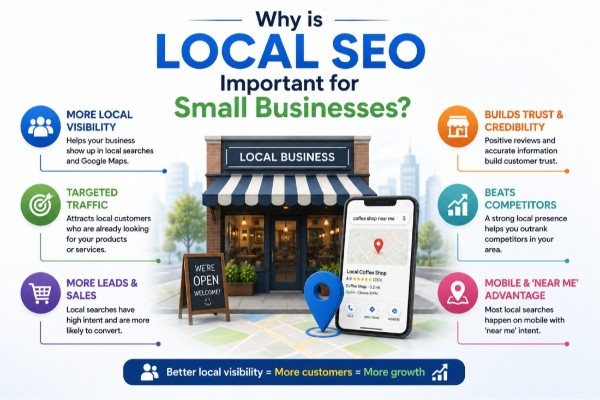
Answer: It helps small, geographically-tied businesses become visible to nearby customers actively searching for their products or services, often competing more directly with other local businesses rather than large national sites.
Example: A local bakery competing for visibility against other bakeries in the same city, rather than large national food brands.
2. Google Business Profile Questions
11. What is Google Business Profile (GBP)?
Answer: Google Business Profile is a free tool that allows businesses to manage how their information appears across Google Search and Maps, including details like address, hours, and reviews.
Example: A restaurant updating its holiday hours directly through its Google Business Profile.
12. What information should be included in a Google Business Profile?
Answer: Key details include an accurate business name, address, phone number, categories, hours, website link, photos, and a clear business description.
Example: A salon listing accurate operating hours and its correct primary category as Hair Salon rather than a broader, less relevant category.
13. What is a primary category in Google Business Profile and why does it matter?
Answer: The primary category defines the main type of business, playing an important role in determining which searches the profile may be relevant for.
Example: A bakery that also sells coffee choosing Bakery as its primary category rather than Coffee Shop, based on its main offering.
14. Can a business have multiple categories on Google Business Profile?
Answer: Yes, businesses can typically add one primary category along with additional secondary categories that reflect other relevant aspects of the business.
Example: A restaurant listing Restaurant as primary and adding Caterer as a secondary category if catering is also offered.
15. What are Google Business Profile posts?
Answer: GBP posts allow businesses to share updates, offers, or events directly on their profile, giving searchers timely information without needing to visit the website.
Example: A gym posting about a limited-time membership discount directly on its Google Business Profile.
16. What is the Google Business Profile Q&A feature?
Answer: The Q&A feature allows users to ask questions directly on a business’s profile, which the business (or other users) can answer, providing helpful public information.
Example: A customer asking Do you have parking available? and the business replying directly through the Q&A section.
17. How do photos affect a Google Business Profile?
Answer: Photos help represent a business visually and can influence how appealing and trustworthy a profile appears to potential customers, though they aren’t a guaranteed direct ranking factor on their own.
Example: A hotel uploading recent, high-quality photos of its rooms rather than relying on outdated stock images.
18. What is profile verification and why is it required?
Answer: Verification confirms that a business genuinely operates at the claimed location or service area, helping maintain the accuracy and trustworthiness of listings shown to searchers. Verification methods can vary by business and may include video, phone, email, or other methods depending on Google’s requirements.
Example: A new business completing a postcard or phone verification process before its profile becomes fully active.
19. What are duplicate Google Business Profile listings and why are they a problem?
Answer: Duplicate listings occur when a business is represented by more than one profile, which can split reviews, confuse customers, and violate Google’s guidelines.
Example: A business accidentally creating a second profile after a rebrand instead of updating the original listing.
20. What is Google Business Profile suspension and what commonly causes it?
Answer: A GBP suspension occurs when Google flags a profile for violating its guidelines, such as inaccurate information, keyword-stuffed business names, or ineligible listings. Recovery typically involves correcting the issue and submitting an appeal.
Example: A profile suspended for adding a city name to the business name field that isn’t part of its real, registered name.
3. Citations, NAP & Reviews
21. What is NAP consistency?
Answer: NAP stands for Name, Address, and Phone number. NAP consistency refers to keeping this information identical across all online listings, directories, and platforms, helping build trust and clarity for search engines.
Example: Ensuring a business’s address is formatted the same way on its website, Google Business Profile, and other directories.
22. What is a local citation?
Answer: A local citation is any online mention of a business’s NAP information, whether or not it includes a link, such as directory listings or mentions in local articles.
Example: A business being listed with its correct NAP details on a local chamber of commerce website.
23. What is the difference between structured and unstructured citations?
Answer: Structured citations appear in a consistent, defined format, typically on directories and listing sites, while unstructured citations appear more organically within articles, blog posts, or social mentions.
Example: A directory listing is structured; a local news article mentioning a business’s address in a sentence is unstructured.
24. Which citation sources are generally considered high value?
Answer: Well-established, relevant directories and platforms particularly those specific to a business’s industry or region are often considered more valuable than generic, low-quality directories with little traffic or credibility.
Example: A restaurant citation on a well-known local dining guide versus an obscure, rarely visited general directory.
25. How do online reviews influence Local SEO?
Answer: Reviews contribute to a business’s prominence and trustworthiness signals, and can influence both click-through rates and, to some degree, local ranking visibility, though they work alongside other relevance and proximity factors.
Example: A business with consistently positive, recent reviews appearing more trustworthy than a similar business with few or outdated reviews.
26. Should businesses respond to negative reviews, and does it affect SEO?
Answer: Responding professionally to negative reviews is generally good practice for reputation management and customer trust. While the direct SEO impact isn’t guaranteed, thoughtful responses can indirectly support prominence and customer confidence.
Example: A business replying calmly to a critical review, addressing the concern and offering a resolution.
27. What is review velocity?
Answer: Review velocity refers to the rate at which a business accumulates new reviews over time. A steady, ongoing flow of genuine reviews is generally viewed more favorably than sudden, unnatural spikes.
Example: A restaurant consistently gaining a few new reviews each week rather than fifty appearing in a single day.
28. What is review gating and why is it discouraged?
Answer: Review gating refers to selectively asking only satisfied customers to leave reviews while filtering out dissatisfied ones before they can post publicly, which violates most platforms’ review policies.
Example: A business only sending review requests to customers who first indicated a positive experience through a private survey.
29. What is citation cleanup and when is it necessary?
Answer: Citation cleanup involves correcting inconsistent or outdated NAP information across directories and platforms, typically needed after a business changes its name, address, or phone number.
Example: Updating dozens of directory listings after a business relocates to a new address.
30. What tools are commonly used for managing citations and reviews?
Answer: Tools like Moz Local, BrightLocal, and Whitespark are commonly used to monitor citation consistency, while platforms like Google Business Profile and dedicated review management tools help track and respond to reviews. The best tool depends on the country, business size, and the directories that matter most for that market.
Example: Using BrightLocal to identify directories with outdated NAP information needing correction.
4. Local Content & On-Page Questions
31. How should local landing pages be structured?
Answer: Local landing pages typically include location-specific content, accurate NAP information, relevant local keywords, and unique details about the service area rather than duplicated content across multiple location pages.
Creating well-optimized location pages also requires following proven On-Page SEO best practices.
Example: A multi-location clinic creating a unique page for each city, mentioning specific local services and staff rather than reusing identical text.
32. What is local keyword research and how does it differ from general keyword research?
Answer: Local keyword research focuses on identifying search terms with geographic intent, often including city or neighborhood names, in addition to standard service or product-related terms.
Example: Targeting emergency plumber in Jaipur rather than just emergency plumber.
33. What is LocalBusiness schema markup?
Answer: LocalBusiness schema is structured data that helps search engines understand key business details like name, address, hours, and category, potentially supporting richer, more accurate search representations.
Example: Adding LocalBusiness schema to a clinic’s website so its hours and address are clearly machine-readable.
34. How does mobile optimization relate to Local SEO?
Answer: Since many local searches happen on mobile devices, often with immediate intent (like finding a nearby business right now), having a fast, mobile-friendly website supports both user experience and local visibility.
Example: A user searching for a nearby pharmacy while walking, expecting a fast-loading, easy-to-navigate mobile page.
35. What is the role of internal linking in Local SEO for multi-location businesses?
Answer: Internal linking helps connect location pages to relevant service pages and to each other, supporting site structure and helping search engines understand the relationship between different locations and services.
Example: A restaurant chain’s homepage linking clearly to each city-specific location page.
To build an effective internal linking structure, it’s also helpful to follow On-Page SEO best practices for organizing pages and improving site navigation.
36. How can content marketing support Local SEO?
Answer: Locally relevant content such as community event coverage, local guides, or region-specific tips can help build local relevance, attract local backlinks, and engage a nearby audience.
Example: A local bakery publishing a blog post about a nearby food festival it’s participating in.
37. What is local link building?
Answer: Local link building involves earning backlinks from locally relevant sources, such as local news outlets, community organizations, or regional business associations, supporting both authority and local relevance.
Building local backlinks is one part of a broader Off-Page SEO strategy, which also includes digital PR, citations, and brand mentions.
Example: A business earning a backlink after being featured in a local newspaper’s small business spotlight.
38. What is the Near Me content strategy, and does it still work?
Answer: Rather than simply inserting near me phrases into content, effective strategies focus on genuinely relevant local content and strong Google Business Profile optimization, since search engines can already infer local intent without exact-match phrasing.
Example: A gym focusing on clear service area information and reviews rather than repeatedly stuffing “gym near me” into its homepage text.
39. How should businesses handle location pages for very similar service areas?
Answer: Each location page should offer genuinely unique, useful content specific to that area rather than a template with only the city name changed, to avoid thin or duplicate content issues.
Example: A law firm’s pages for two nearby cities each referencing specific local courts or community details rather than identical boilerplate text.
40. What is geo-targeting in the context of website content?
Answer: Geo-targeting involves tailoring website content, offers, or messaging based on a visitor’s location, which can complement broader local SEO efforts, though it should be implemented without harming crawlability for search engines.
Example: A retailer showing region-specific promotions to visitors based on their detected location.
5. Advanced & Multi-Location Local SEO
41. What challenges are unique to multi-location Local SEO?
Answer: Multi-location businesses must manage consistent NAP data, unique content, and separate Google Business Profiles across many locations, while avoiding duplicate content and keeping citations accurate at scale.
Example: A retail chain with fifty stores needing individually accurate hours and addresses across every listing.
42. How should a business handle Google Business Profile management at scale?
Answer: Bulk location management tools within Google Business Profile, along with dedicated local SEO platforms, help manage updates, respond to reviews, and monitor consistency across many locations efficiently.
Example: Using Google’s bulk location upload feature to manage profiles for dozens of stores at once.
43. What is a landing page vs a storefront approach for multi-location SEO?
Answer: A landing page approach may consolidate several nearby locations under fewer, well-optimized pages, while a full storefront approach creates individual pages for every physical location, chosen based on business size, resources, and genuine content depth available.
Example: A small regional chain combining two nearby towns under one detailed page rather than creating two thin, near-identical pages.
44. How does local SEO differ for franchises versus independently owned businesses?
Answer: Franchises often need to balance consistent branding from a central entity with location-specific optimization at the individual franchise level, requiring coordination between corporate and local marketing efforts.
Example: A franchise location managing its own Google Business Profile and reviews while following brand guidelines set by the parent company.
45. What is spam in the context of local search results, and how does Google address it?
Answer: Local spam includes practices like fake listings, keyword-stuffed business names, or misrepresented locations designed to manipulate local rankings. Google allows users to report such listings and takes enforcement action against violations.
Businesses should also follow Google Business Profile guidelines to avoid policy violations that could lead to profile suspension or removal.
Example: A business adding a city name to its listed business name to rank for additional locations it doesn’t legitimately serve.
46. What is the role of Google Maps in Local SEO beyond the standard search results?
Answer: Google Maps serves as both a navigation tool and a discovery platform, where users can browse and compare nearby businesses directly, making accurate map presence important beyond just search result rankings.
Example: A user browsing nearby restaurants directly within the Maps app before deciding where to eat.
47. How do voice searches typically affect Local SEO?
Answer: Voice searches often carry local intent and use natural, conversational phrasing, but they don’t require a fundamentally different optimization approach clear, well-structured local information continues to serve both text and voice queries.
Example: A voice query like Where’s the nearest pharmacy that’s open now? relying on the same accurate hours and location data as a typed search.
48. What KPIs are commonly used to measure Local SEO performance?
Answer: Common KPIs include local pack rankings, Google Business Profile views and actions (calls, direction requests, website clicks), review volume and rating trends, and organic traffic to location-specific pages.
Example: Tracking a rise in get directions clicks on a store’s profile after a citation cleanup campaign.
49. How do Google’s broader ranking and spam systems affect Local SEO strategy?
Answer: These systems reinforce the importance of accurate, genuine business information and authentic engagement (like real reviews) over manipulative tactics such as fake listings or review gating, which carry an increased risk of penalties or suspension.
Example: A business avoiding review gating and instead focusing on naturally encouraging all customers to leave honest feedback.
50. What’s your process for conducting a Local SEO audit?
Answer: A typical audit reviews Google Business Profile accuracy and completeness, NAP consistency across citations, review volume and management, local landing page quality, and local keyword visibility, while also checking for duplicate listings or spam issues.
Example: Auditing a client’s ten location profiles and discovering three with outdated hours and one duplicate listing needing removal.
Interview Tip: When answering this question, explain your audit process step by step instead of listing tools. A structured approach demonstrates practical Local SEO experience and problem-solving skills.
Along with Local SEO checks, reviewing your website’s Technical SEO audit and best practices can help identify crawlability, indexing, and performance issues that may also affect local search visibility.
Final Tips for the Interview
- Be ready to discuss a real or practice Google Business Profile you’ve optimized, even a small personal or sample project.
- Understand how Local SEO connects to reviews, citations, and content, since interviewers often test how these pieces work together.
- Avoid presenting “near me” optimization as a special standalone tactic focus on genuine local relevance instead.
- Stay updated on Google’s local spam policies and guideline changes, as this shows genuine engagement with the field.
If you’re preparing for SEO interviews, strengthen your overall knowledge by reviewing our Technical SEO Interview Questions and Answers guide.
Ready for a Real Digital Marketing Interview?
You’ve mastered the most important Local SEO interview questions. Now challenge yourself with our Digital Marketing Quiz and see how well you understand SEO, PPC, social media, analytics, content marketing, and other core digital marketing concepts.