The use of search engines is now a part of our daily life and profession. But what counted as a “search engine” in 2022 and what counts in 2026 are two different things entirely.
When I first wrote this post four years ago, search meant typing a query into Google, scanning 10 blue links, clicking one, and finding your answer. That model is still alive but it is no longer the whole picture.
In 2026, your search query might be answered by an AI summary before a single website link appears. You might ask AI Mode, Gemini, ChatGPT, Claude.ai etc. instead of Google.
You might speak to an AI agent embedded in your phone’s operating system and never open a browser at all. In fact according to the heroicrankings.com
- 43% of Google AI Overviews point back to Google.
- Nearly 30% of all Google AI Overview mentions go to the top 50 domains on the search engine.
- 40% of sources that appear in Google AI Overviews rank in spots between 11 and 20 on the SERP.
- 88% of keywords that trigger AI Overviews are of informational intent.
- 81% of Google AI overviews also include a “People Also Ask” section.
- Roughly 81% of searches that trigger an AI Overview are performed on mobile data.
- 63% of businesses said that Google AIOs have had a positive effect on their organic traffic, visibility, and or search rankings since their rollout.
The pie is bigger. The pieces just look different now.
Search engines still work as guides, sources of business, assistants, teachers, and inspirations. Their uses depend on the curiosity, imagination, creativity, age, profession, situation, and knowledge of the user. That has not changed. What has changed is how those uses are fulfilled and who is doing the searching versus who is doing the answering.
This updated guide covers what you need to know about the real uses of search engines in 2026, including where AI fits in and how this shift affects students, professionals, and business owners in India and globally.
What is a search engine?
At its foundation, a search engine is a system built on programming, databases, and increasingly on artificial intelligence that helps users find relevant information in response to a query.
At the micro level, a search engine is a scripted group of programs written using languages such as Python, SQL, PHP, or Maria DB. But in 2026, that foundation now includes large language models (LLMs), neural networks, and real-time AI reasoning layers that do far more than match keywords to pages.
The old model: user types query → engine returns ranked links.
The new model: user types or speaks a query → AI interprets intent → synthesizes an answer from multiple sources → sometimes shows links, sometimes does not.
Google now calls this “AI Overviews.” OpenAI calls it “ChatGPT Search.” Perplexity built its entire brand on it. They are all doing the same fundamental thing: replacing a list of links with a composed answer.
The Search Landscape in Numbers (2026)
According to the sources:
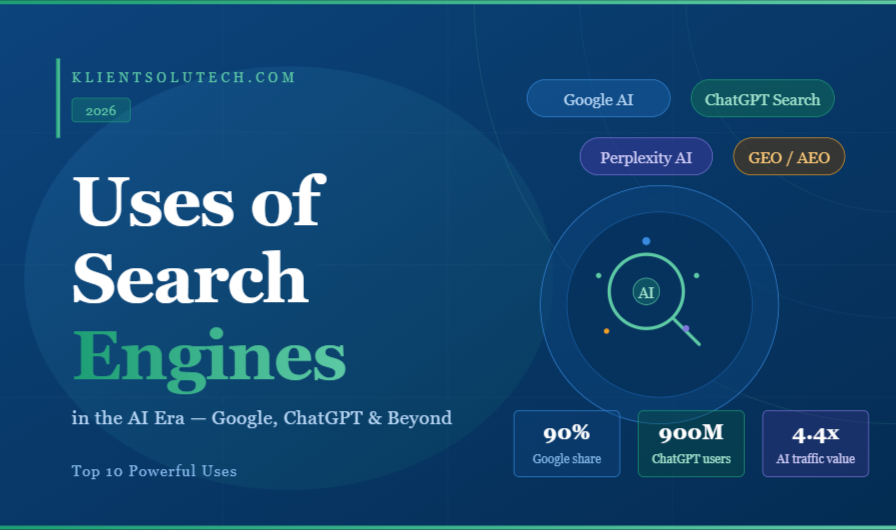
- Google still holds approximately 90% of global search market share (StatCounter, March 2026)
- AI Overviews now appear in 25% of all Google searches up from 4% in January 2025
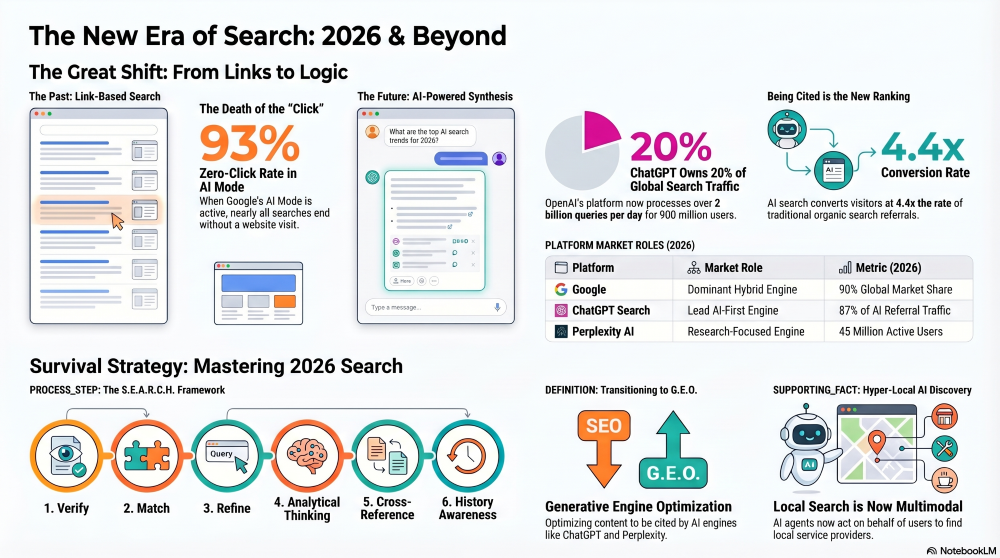
- ChatGPT processes over 2 billion queries per day and has 900 million weekly active users (OpenAI, February 2026)
- 58.5% of Google searches in the US now end without a single click to a website
- When Google’s AI Mode is active, that zero-click figure rises to 93%
The implication for anyone with a website or blog is significant.
A search engine can be a full website like Google, a web application, downloadable software, or even a simple search bar in a website’s sidebar. Technically, any program that helps users find data within a website or across the web qualifies as a search engine.
But in common usage, the term is reserved for platforms like Google and Bing. Why? Because they operate at a completely different scale crawling billions of pages, applying advanced filters, and delivering real-time results. A search box on a blog finds content within that site. Google finds everything, everywhere.
That scale difference is what separates a search feature from a search engine. And it points directly to what makes a search engine genuinely good.
Characteristics of High-Quality Search Engines (Still True, Now More Important)
A good search engine:
- Responds to user queries quickly and accurately
- Is unbiased not filtered by political or commercial pressure
- Ranks results based on quality, relevance, and ethical standards
- Blocks harmful, vulgar, or anti-social content
- Protects user privacy and data
- Shows personalised, contextually relevant results not just generic or commercially profitable ones
- Follows good business ethics
- In 2026: cites its sources transparently and does not hallucinate facts
That last point is new and critical. AI-powered search can confidently give you wrong answers. The best engines Perplexity, Google AI Overviews, and increasingly ChatGPT Search are improving their citation transparency.
But as a user (student/teacher), you should always verify important information from the primary source. As a content creator, your job is now to be that primary source.
Popular Search Engines in 2026
The landscape has expanded considerably since 2022.
- Google ~90% market share → Search Engine Journal, March 2026 citing StatCounter data showing Google at 90.01%, Bing at 4.98%
- ChatGPT 900 million weekly users, 5th most visited website → Search Engine Journal citing OpenAI’s own February 2026 figures
- ChatGPT drives 87% of AI referral traffic → Conductor 2026 AEO/GEO Benchmarks Report, also corroborated by SE Ranking
- Perplexity 45 million active users → SEOmator citing Business of Apps, 2026
- Perplexity citation transparency / senior professional audience → Exposure Ninja – 30% of Perplexity users are in senior leadership roles, 65% in high-income white collar professions
- Google AI Mode rolled out globally in 2025 → Search Engine Journal and AI Search Trends 2026
- Bing/Copilot ~5% market share → StatCounter via Search Engine Journal
- Baidu ERNIE model → Search Engine Journal — mentions ERNIE 5.0 launched November 2025 and 200M monthly active users by January 2026
Platform-specific search (unchanged but growing):
- YouTube, Instagram, Amazon, Pinterest, LinkedIn all have powerful internal search systems that index only their own content. These are not search engines in the Google sense, but for many users in 2026, they are the first point of search.
The S.E.A.R.C.H. Framework – Using Search Engines Effectively in 2026
Because search has become more complex, I want to give you something useful before the list: a simple framework for navigating it.
S — Source check. Verify who is behind the result. AI Overviews and ChatGPT responses synthesise from multiple pages. Always check the original source for health, finance, and career decisions.
E — Engine match. Different engines suit different needs. Google for current news and local search. Perplexity for research with citations. ChatGPT for step-by-step explanations. YouTube for tutorials. Use the right engine for the right task.
A — Analytical thinking. Search gives you data; it does not make decisions for you. Your brain is still the most important tool.
R — Refine your query. In 2026, longer queries work better. ChatGPT prompts average 60 words – considerably longer than old Google searches – because conversational, specific questions get better answers.
C — Cross-reference. One result is not enough for important decisions. Always check 2-3 sources.
H — History awareness. Your search history and behaviour shape what AI and algorithmic engines show you. Be aware of this personalisation bubble.
Now, the top 10 uses.
Top 10 Powerful Uses of Search Engines in 2026
1. Research and Learning
The largest use of search engines from Google to Bing, ChatGPT remains research and learning. Students, teachers, professionals, and curious individuals use search to find facts, data, instructions, and knowledge on virtually any subject.
What changed in 2026 is where the answer lands. When a student typed “what is photosynthesis” in 2022, they got a list of links. Today, Google’s AI Overview gives them a complete answer on the results page no click required. That is useful for quick learning, but it means the websites that used to get that click have lost it.
For students: search engines remain your most powerful classroom supplement. The ability to find the right information, verify it, and apply it is one of the most important skills in any career.
For researchers: AI tools like Perplexity are genuinely useful for initial literature scanning, but they can miss recent studies and sometimes misattribute sources. Always verify from the original publication.
The 2026 shift: Learning has gone conversational. Instead of “what is machine learning,” students now type “explain machine learning like I’m a working professional trying to switch careers.” Longer, more specific queries get better answers on every platform.
Related: How can artificial intelligence benefit humans?
2. Decision-Making
We use search engines to inform decisions which laptop to buy, which career to choose, which city to move to, whether to start a freelance business. This use has not gone away. It has become significantly more powerful and slightly more dangerous.
More powerful because AI tools Best Free AI Tools for Non-Tech Professionals in 2026can now synthesise comparison data, pros and cons, and contextual advice faster than any 2022 search could manage. Ask ChatGPT “should I pursue digital marketing or data analytics as a career in India in 2026” and you get a nuanced, structured answer in seconds.
Slightly more dangerous because that nuanced answer may be built on outdated training data, geographic assumptions that do not apply to you, or confident-sounding misinformation. AI systems are very good at sounding certain even when they are not.
My advice after 15+ years in digital marketing: use AI search to generate options and frame your thinking. Then verify key facts from human experts, recent publications, or people who have actually done what you are considering.
The 2026 shift: People are now asking AI tools for advice the way they used to ask a trusted senior colleague. The AI is more available and often more patient but it is not accountable for the outcomes.
Read following posts:
Disadvantages of Artificial Intelligence Technologies and Tools
3. Solving Technical Problems
Search engines remain the go-to tool for solving technical errors in software, hardware, WordPress, code, or any other system. This has not changed. What has changed is the quality and speed of the answer.
In 2022, solving a WordPress database connection error meant: search on Google → open 5 tabs → read instructions from forums → try each one. In 2026, you paste the error message directly into ChatGPT or Claude, Gemini or Perplexity, describe your server environment, and get a step-by-step diagnostic in one conversation.
I have watched digital marketing students in my training programs use this workflow to solve problems in minutes that used to take an entire class session. It is genuinely useful and it is accelerating the pace at which beginners can become competent practitioners.
That said, AI tools sometimes suggest solutions that worked in a previous version of software and break the current one. Always check the date relevance of any technical advice, and use official documentation as the final authority.
The 2026 shift: Stack Overflow and blog tutorials have not disappeared, but they are increasingly being accessed through AI summaries rather than direct clicks. If you write technical content, structure it for AI extraction: clear headings, direct answers first and code examples labelled clearly.
4. Finding Local Services
Whether you are searching for a web designer in florida, a plumber in Delhi, or a digital marketing agency in Australia, search engines remain the primary tool for local service discovery.
Google Business Profile (formerly Google My Business) is still the most important local presence tool in 2026. When someone searches “digital marketing course near me” or “WordPress developer in Himachal Pradesh,” businesses with active, well-maintained Google Business Profiles appear in the map pack results.
What has shifted is that voice search and AI assistants are now handling a growing share of local queries. When someone says “find me a good web designer near Shimla” to their phone’s AI assistant, the results come from a combination of Google Business data and AI reasoning about quality indicators.
For local business owners and freelance agencies in India your Google Business Profile is not optional but mandatory. A complete profile with recent photos, accurate hours, and genuine customer reviews directly impacts how often you appear in local AI-assisted queries.
The 2026 shift: Local search has become multimodal. Queries arrive via text, voice, and increasingly through AI agents acting on behalf of users. Your business data needs to be consistent and complete across all platforms Google, Justdial, Sulekha, and your own website because AI tools pull from multiple sources.
5. Shopping and Product Research
Search engines remain a primary starting point for shopping but the shopping journey looks different now.
In 2022: search “best laptop under 50000 rupees” → see Google Shopping ads and organic blog comparisons → click several → read → decide.
In 2026: the same search might return an AI Overview summarising the top three laptops with key specs, followed by shopping ads, followed by organic results. Many users are making shortlist decisions before clicking a single product page.
Here is the data point that matters for both shoppers and business owners: 42% of consumers report using AI to assist in their last product or service purchase (Digital Third Coast, January 2026). One in four consumers now begins product research with an AI chatbot before going to Google or Amazon.
For shoppers: AI comparison tools are useful for initial shortlisting. For final purchase decisions involving significant money, verify reviews from verified buyers on Amazon, Flipkart, or Trustpilot not just AI summaries.
For business owners and e-commerce marketers: your product descriptions, reviews, and specifications need to be structured for AI extraction, not just for traditional keyword ranking. Products without structured data, clear specifications, and third-party reviews are increasingly invisible in AI-assisted shopping.
The 2026 shift: 24% of consumers are now comfortable with AI agents shopping for them autonomously rising to 32% among Gen Z consumers. Shopping via AI is not science fiction. It is happening now, especially for reorder and subscription products.
6. Promoting Local Business
This use has become more important and more complex since 2022.
The basic principle remains same: maintain an active Google Business Profile, collect genuine reviews, keep your information updated, and appear when local searchers need you. That still works. Read Here: 6 Marketing Strategies to Promote Your Local Business Online
What is new is that AI Overviews are now appearing for local queries too. When someone searches “best digital marketing trainer in Himachal Pradesh,” Google may generate an AI summary that mentions specific names and businesses – drawn from a combination of your website content, Google Business Profile, and third-party mentions.
This means the content on your website matters more than it used to. A local business with a well-maintained website, clear service descriptions, genuine customer testimonials, and consistent business information across the web is more likely to be cited in AI-generated local answers.
The 2026 opportunity: if you are a local service provider, becoming a named entity that AI tools recognise and cite is the new version of ranking on page one.
7. Getting Free Organic Traffic to Your Website
This is where the AI shift hits hardest and where the real conversation for content creators needs to happen.
In 2022, if you wrote a high-quality, SEO-optimised blog post and ranked on page one of Google, you could expect a 15–20% click-through rate from the top position. In 2026, with an AI Overview present on the same query, that CTR drops to around 8% – a 47% reduction for the same ranking. For queries where AI Mode is active, 93% of searches end with no external click at all.
This is real, and it is affecting traffic across millions of other content rich websites.
But here is the part most people miss: total search usage has grown 26% globally. The pie is bigger. AI search converts visitors at 4.4x the rate of traditional organic search (Semrush, 2025). If your content gets cited in ChatGPT, Perplexity, or Google AI Overviews, those visitors are more engaged and more likely to take action than a traditional organic visitor.
The new goal is not just to rank it is to be cited.
How to do that:
- Write direct, complete answers at the start of each section (not buried at the end)
- Use structured data and clear headings that AI can extract cleanly
- Build branded mentions across the web – reviews, guest posts, Quora answers, forum participation
- Keep your content fresh and updated (this is exactly what updating this post does)
- Earn backlinks from authoritative sites – domain authority is still the strongest predictor of AI citations
The content strategy has not changed in principle. The execution now needs to serve both Google’s algorithm and AI extraction systems simultaneously.
8. Generating Leads and Sales Through Advertising
Google Ads still works. Bing Ads still works. Search engine advertising remains one of the most effective ways to generate leads and sales for service businesses because the user is already looking for what you offer.
What has changed in 2026 is that advertising is now appearing within AI-generated answers too. Ads alongside Google AI Overviews grew from 3% of AI Overview appearances in January 2025 to approximately 40% by November 2025 (Search Engine Land). Google is integrating commercial intent and advertising directly into AI-generated results.
This creates a new opportunity for businesses that advertise on Google are now appearing not just in traditional search results but within AI-generated responses to commercial queries. If someone asks Google “what is the best digital marketing agency for small businesses in India,” the AI Overview might appear with ads from relevant agencies.
For Indian businesses and freelancers search advertising remains a high-ROI investment. Start with a small budget, target specific commercial keywords with local intent, and track which queries are driving actual inquiries not just clicks.
The 2026 shift: Search engine marketing (SEM) now requires understanding where your ads appear in traditional results, in AI Overviews, or in AI Mode. These are different placements with different user behaviours. Google Ads dashboards are starting to distinguish between these contexts.
9. Staying Updated on Trends and Industry News
Search engines remain the first destination for staying aware of industry trends but the tools have become significantly more sophisticated.
In 2022, you would search “digital marketing trends” and read a list of predictions. In 2026, you can ask ChatGPT or Perplexity: “What are the most significant changes in SEO in the last 3 months, with sources?” and get a synthesised briefing.
For professionals: this is genuinely useful. AI tools are accelerating the time it takes to go from “I heard something changed” to “I understand what changed and what it means for my work.”
Google Trends is still valuable and still free. Type a term, see whether it is growing or declining in search interest, and compare it to competitors. This remains one of the most underused tools for content planning.
For content creators and marketers: trends discovered in search data tell you what your audience is actively looking for not what you think they want. Build your content calendar around search volume data, not assumptions.
The 2026 shift: AI tools are now proactive, not just reactive. Tools like Claude.AI, ChatGPT with browsing enabled, Perplexity, and Google’s AI features can surface relevant news and updates without you even asking. Setting up AI-assisted monitoring, AI agents for your niche is now a practical option for busy professionals. Even Claude Cowork is so much powerful who even audit, scroll, read and make changes to your websites and content.
10. Everyday Uses Now Supercharged by AI
Search engines have always done more than answer big questions. They handle the small moments too conversions, translations, weather, scores, quick calculations. That has not changed.
What has changed is the quality and speed of these everyday functions.
- Currency conversion, unit changes, and quick calculations still work on Google in milliseconds
- Translation is now significantly better, with AI tools handling nuance and context that old tools missed.
- Weather and local information remains one of Google’s strongest features
- Sports scores, match updates, and live data are instantly available
- Dictionary and language learning tools are now AI-powered you can have a real conversation with a language tutor inside ChatGPT
For students and professionals using search engines in Indian languages: 2026 has seen significant improvements in Hindi, Tamil, Telugu, and other Indian language search results and AI responses. Google has expanded AI Overviews to 40 languages. ChatGPT performs well in Hindi and other major Indian languages.
The everyday uses of search engines are not diminishing. They are becoming faster, more conversational, and embedded deeper into the devices and applications we already use.
The Impact of AI-Powered Search — What It Means for You
The rise of AI search is not just a technical development. It has real-world consequences for how information reaches people and the same ethical considerations that applied to traditional search apply even more urgently now.
When millions of people rely on an AI-generated answer for a health question, a career decision, or a financial choice, the accuracy and balance of that answer matters enormously.
AI systems can reflect the biases in their training data. They can confidently state incorrect information. They can miss regional context giving an answer appropriate for the US market to someone in India.
This is why critical thinking remains the most important skill in the AI era. Search engines traditional or AI-powered are tools for finding information. They are not replacements for judgement, professional advice, or verified expertise.
As a content creator and educator, my responsibility is to provide accurate, experience-based, helpful information. As a user, your responsibility is to verify what matters especially before making decisions that affect your health, career, or finances.
Importance of Search Engines in 2026
Search engines in 2026 are more powerful and more embedded in daily life than at any point in history.
Google’s parent company Alphabet continues to be one of the most valuable companies in the world. OpenAI the company behind ChatGPT – reached a $300 billion valuation in early 2026. These are not trivial businesses. They are the infrastructure of how humanity finds and processes information.
For students in India: understanding how to use search engines including AI-powered tools – is now a baseline professional skill. Employers expect it. Freelance clients expect it. Anyone who can navigate these tools effectively has a real competitive advantage.
For business owners: your visibility in search results and AI-generated answers is tied directly to your revenue. A business that cannot be found in search does not exist to most potential customers.
For content creators and bloggers: the rules have shifted, but the opportunity has not disappeared. High-quality, experience-based, regularly updated content that earns AI citations is more valuable than ever because the competition for that citation is significant, and the reward for earning it (high-quality, converting traffic) is growing.
FAQs – What People Are Asking About Search Engines in 2026
What is the difference between Google search and ChatGPT search?
Google returns ranked links and increasingly, AI-generated summaries (AI Overviews). ChatGPT synthesises a direct conversational answer from its training data and real-time web retrieval. Google is better for news, local search, and finding specific websites. ChatGPT is better for step-by-step explanations, brainstorming, and research that benefits from a conversational follow-up.
Is AI replacing Google?
Is AI replacing Google?
Not yet, and probably not completely. Google still holds around 90% of global search market share as of March 2026. But AI tools are taking share in specific categories research, technical questions, and product comparisons among younger users. The more accurate picture is that AI has expanded the search market overall, rather than simply replacing Google.
How do search engines make money?
Primarily through advertising. When you search a commercial term “best laptop under 50000 rupees” the ads at the top of the results page are paid placements. Google earns the vast majority of its revenue from this model. AI Overviews are now beginning to include ads as well, signalling that the commercial model of search is being adapted for the AI era.
Are AI search engines reliable?
They are useful, but not always reliable. AI tools can produce confident-sounding incorrect answers this is called hallucination. For factual questions with clear answers, they perform well. For nuanced or recent information, always verify from the primary source. Perplexity and Google AI Overviews provide citations that make verification easier.
How do I make my website appear in AI-generated search results?
Focus on three things: (1) Write clear, direct, factual content that answers specific questions completely. (2) Build your website’s authority through backlinks, mentions, and reviews from credible third-party sources. (3) Use structured data and keep your content regularly updated. Domain authority is the strongest predictor of AI citations, according to SE Ranking’s analysis of 2.3 million pages.
What is GEO (Generative Engine Optimization)?
GEO is the emerging practice of optimising content to be cited by AI-powered search engines like ChatGPT, Perplexity, and Google AI Overviews in the same way that traditional SEO focused on ranking in Google’s organic results. It is a growing field, and the GEO market is projected to grow from $886 million in 2024 to $7.3 billion by 2031.
Are search engines safe for children in 2026?
Mainstream search engines have improved content filtering significantly. Google’s SafeSearch, for example, has become more accurate. But no filter is perfect. For younger children, parental controls and supervised browsing remain important. AI tools like ChatGPT have content restrictions for minors, but these can be bypassed. Parental guidance is still the most reliable safety mechanism.