Online Privacy in AI is one of the most critical issues in the digital world. Protecting personal data is no longer optional it is essential. With the rapid growth of artificial intelligence, smartphones, cloud services, and smart devices, personal information is constantly being collected, analyzed, and stored, often without users fully realizing it.
Every time we click on a link, search for information, give a voice command, share our location, or scan our face, we add more data to a constantly growing digital collection something most users rarely notice in real time.
But here’s the real question: how much of your privacy are you giving up without even knowing it?
Online privacy and personal data have become serious matters because of AI and modern technology.
AI systems analyze this information to provide personalized experiences, faster services, and smarter decision-making. While these technologies make life more convenient, they also raise an important concern:
How much of our privacy are we giving up in exchange for convenience?
We must think carefully about what we are losing while trying to improve our lives with AI systems because convenience should not come at the cost of control. AI is changing the way we live, and we need to understand what this means for our privacy.
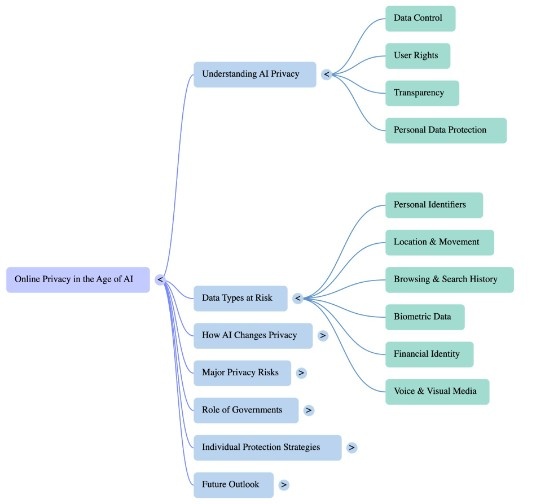
What You’ll Learn About Online Privacy in AI
- How artificial intelligence is affecting online privacy
- What types of personal data are most at risk today
- How governments are using AI and what policies exist
- Why current laws are often insufficient in the AI era
- What governments must clearly define in privacy policies
- Practical ways individuals can protect themselves
AI is not going away. It is a powerful tool that continues to evolve. Understanding how AI affects privacy helps us make smarter and more informed decisions about our digital lives.
What Is Online Privacy in AI?

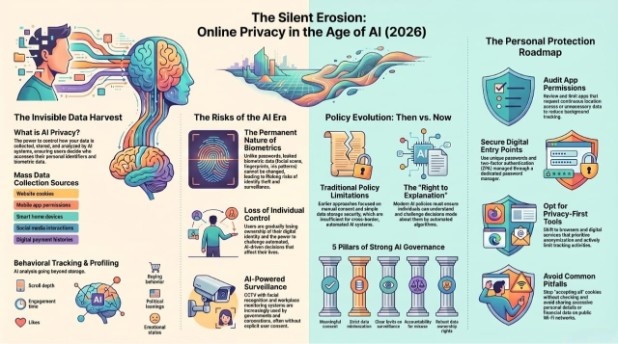
Online privacy in AI means having control over what happens to your personal information in systems powered by artificial intelligence. It refers to how your data is collected, stored, shared, analyzed, and protected. You should be able to decide who can access your information and how it is used.In today’s AI-driven environment, this control is becoming harder to maintain as data collection happens automatically in the background.
Online privacy includes:
- Personal identifiers (name, email, phone number)
- Location and movement data
- Browsing history and search queries
- Photos, videos, and voice recordings
- Financial and digital identity information
- Biometric data such as fingerprints and facial scans
Today, personal data is not just stored it is analyzed, compared, and used to predict future behavior, often without users being fully aware of how deeply they are being tracked,often without users being fully aware of how deeply they are being tracked. In many cases, this data is also monetized without users fully understanding what is happening.
Read More – https://klientsolutech.com/importance-of-learning-ai-for-students/
How AI Is Changing Online Privacy in 2026

AI observes what people do online and creates detailed digital profiles based on behavior. These profiles are used for advertising, automated decisions, and personalized experiences often without users even realizing it.In many cases, users are not actively giving permission they are simply accepting it without understanding the consequences.
AI systems grow more powerful as they receive more data. This creates a conflict between technological advancement and personal privacy.
Mass Data Collection by AI Systems
AI-powered systems collect massive amounts of data from multiple sources, including:
For example, a simple mobile app asking for location access can continuously track your movement patterns throughout the day.
- Website cookies and trackers
- Mobile app permissions
- Smart devices (smart TVs, wearables, voice assistants)
- Social media interactions
- Online purchases and digital payments
Most users unknowingly agree to this data collection by accepting long and complicated privacy policies. These policies are rarely read or fully understood, which results in unintentional consent.
Read More – https://klientsolutech.com/best-free-ai-tools-for-non-tech-users-2026/
Behavioral Tracking and AI Profiling
AI does more than store data; it analyzes behavior.
It tracks:
- What you search for
- What you scroll past or engage with
- How long you stay on a webpage
- What you like, share, or ignore
What you like, share, or ignore
This level of tracking goes far beyond what most users expect when they use digital platforms.
Using this information, AI builds highly detailed user profiles that can predict:
In some cases, this profiling is accurate enough to influence decisions before users even make them consciously.
- Buying behavior
- Political preferences
- Emotional state
- Health and mental well-being patterns
When profiling is misused, it can influence opinions, manipulate choices, and reduce personal freedom.
Facial Recognition and Biometric Data Risks
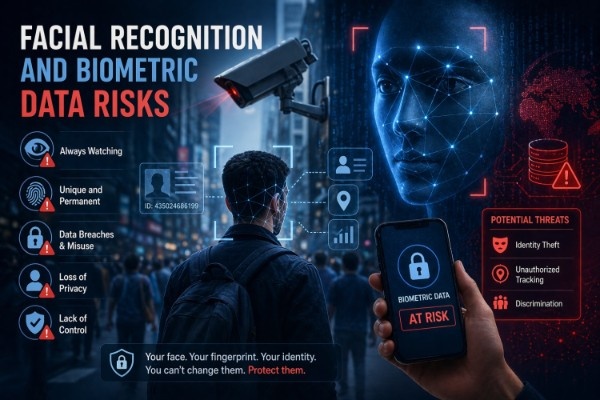
Biometric data is one of the most sensitive forms of personal information.
AI systems widely use:
- Facial recognition
- Fingerprint scanning
- Voice identification
- Iris scanning
For instance, facial recognition is already used in airports, public surveillance, and even smartphone unlocking systems.
Unlike passwords, biometric data cannot be changed. If this data is leaked or misused, the risks are long-term because biometric identity cannot be replaced like a password individuals may face long-term risks such as identity theft, fraud, or constant surveillance.
AI Surveillance and Monitoring
AI-powered surveillance systems are used by governments and companies for:
- CCTV and facial recognition
- Traffic and crowd management
- Workplace monitoring
- Public safety and crime prevention
In many situations, people are being monitored without clear awareness or explicit consent.
While these tools improve efficiency and security, they also raise serious concerns about constant monitoring, loss of personal space, and misuse of authority about constant monitoring, loss of privacy, and misuse of power.
Major Privacy Risks of AI
The rapid growth of AI without strong regulation and user awareness creates serious privacy risks, including:
- Large-scale data breaches and leaks
- Identity theft and digital impersonation
- Unauthorized data sharing without user consent
- Deepfakes and AI-generated misinformation
- Manipulative targeted advertising based on behavior
- Loss of anonymity and freedom of expression
In recent years, several global data breaches have exposed millions of users’ personal information, showing how vulnerable digital systems can be.
Personal data can be used against individuals without their knowledge or consent, reducing their control over their own digital lives.
The Real Loss of Privacy in the AI Era
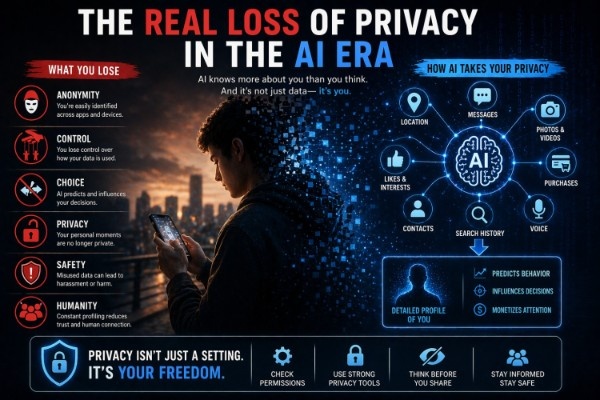
The biggest loss for users in the AI era is control over their own data and identity.
As AI systems grow stronger, users are gradually losing:
- Ownership of their digital identity
- Transparency over how data is used
- The ability to opt out of surveillance
- The power to challenge AI-driven decisions
This shift is happening silently, which makes it even more dangerous because most users don’t realize what they have already lost.
Governments and corporations often hold most of the data, while individuals remain unaware of how extensively their lives are monitored.
Role of Governments in AI Privacy Protection

Governments are responsible for ensuring that AI development does not harm citizens’ privacy and fundamental rights.They must balance innovation with safety, fairness, and accountability.
However, in many countries, regulations are still catching up with the speed at which AI technologies are evolving.
Data Protection Laws
Some regions have introduced laws to protect personal data. These laws generally aim to:
- Limit unnecessary data collection
- Enforce transparency and consent
- Penalize data misuse or breaches
However, many of these laws were created before AI became as advanced and data-driven as it is today.
Government AI Inclusion: Benefits and Risks
Governments use AI for:
- Digital identity verification
- Welfare scheme targeting
- Healthcare diagnostics
- Smart city infrastructure
- Law enforcement and surveillance
While these applications improve efficiency, they also concentrate large amounts of sensitive data in centralized systems increasing the risk of misuse, profiling, data breaches, and over-surveillance.
Government Privacy Policies: Then vs Now
Earlier Policy Approach
Traditional policies focused on:
- Data storage security
- Manual consent systems
- Limited IT compliance
These were sufficient in a pre-AI environment.
AI-Era Challenges
Modern AI systems:
- Make automated decisions
- Process biometric and behavioral data
- Operate across borders
- Use massive datasets
As a result, existing policies often fail to explain AI decisions, regulate bias, control surveillance, or enforce accountability.
What Governments Must Clearly Define in AI Privacy Policies
Governments must clearly explain:
- What personal data is collected
- How that data is used
- Who can access the data
- What happens if policies are violated
Privacy policies must be easy to understand and transparent to build public trust.
Key Elements of Strong AI Privacy Policies
Meaningful Consent
Users must clearly understand:
- What data is collected
- Why it is collected
- How long it is stored
- Who can access it
Consent must be informed, simple, and revocable.
Data Minimization
Only necessary data should be collected. Laws should prevent excessive or unnecessary data collection.
Right to Explanation
People must know when AI systems are making decisions about them and should be able to challenge incorrect or biased outcomes.
Limits on Surveillance
Governments must clearly define:
- Where AI surveillance is allowed
- Where it is prohibited
- How long data is stored
- Who can access it
Unchecked surveillance threatens democratic freedoms.
Accountability and Penalties
Both governments and companies must be accountable for:
- Data misuse
- Privacy violations
- AI-related harm
Penalties must be strong enough to prevent abuse.
Data Ownership Rights
Individuals should have the right to:
- Access their data
- Correct it
- Delete it
- Transfer it
How Companies Misuse User Data
Many companies exploit loopholes by:
- Collecting excessive data
- Sharing data with third parties
- Using vague privacy language
- Making opt-out options difficult
AI accelerates this exploitation by processing data at a massive scale.
Can AI Improve Privacy?
AI itself is not harmful. When used responsibly, it can:
- Detect fraud and cyber threats
- Identify data breaches early
- Improve encryption and security
- Anonymize sensitive information
The real issue lies in governance, ethics, and accountability – not the technology itself.
How to Protect Your Online Privacy in AI
While complete privacy may not be possible, taking the right steps can significantly reduce your exposure to AI-driven data tracking.
Manage App Permissions
- Allow only necessary permissions and regularly review what apps have access to your data.
Strengthen Account Security
- Use strong and unique passwords, enable two-factor authentication, and consider using a password manager.
Choose Privacy-Focused Tools
- Use browsers and digital services that prioritize user privacy and limit tracking activities.
Be Cautious on Public Wi-Fi
- Avoid accessing sensitive accounts or financial information on unsecured public networks.
Review Social Media Privacy Settings
- Limit profile visibility, remove unnecessary connections, and review third-party app access.
Keep Software Updated
- Keep your devices and applications updated, as updates often fix critical security and privacy vulnerabilities.
Common Privacy Mistakes to Avoid
- Accepting all cookies without checking
- Using the same password across multiple platforms
- Ignoring app permission settings
- Sharing excessive personal information online
Future of Privacy in an AI-Driven World
The future of online privacy in AI depends on:
- Strong government policies
- Ethical AI development
- Responsible companies
- Informed users
If awareness and regulation fail, the erosion of privacy will continue silently and reversing it later may become impossible.With the right balance of awareness, regulation, and responsibility, AI and privacy can coexist.Understanding online privacy in AI today is the first step toward protecting your digital freedom tomorrow.
FAQs
What is online privacy in the age of AI?
Online privacy in the age of AI refers to protecting personal data from being collected, analyzed, or misused by artificial intelligence systems.
Why is online privacy becoming more important in 2026?
Because AI systems collect massive amounts of personal data from devices, apps, and online activities.
How does AI collect personal data?
AI collects data through website cookies, mobile apps, smart devices, social media platforms, and online transactions.
What are the biggest privacy risks of AI?
Major risks include data breaches, identity theft, surveillance, targeted manipulation, and unauthorized data sharing.
Can AI misuse biometric data?
Yes. AI systems that use facial recognition, fingerprints, or voice data may expose users to serious privacy risks if the data is leaked.
How can users protect their privacy online?
Users can protect their privacy by limiting app permissions, using strong passwords, enabling two-factor authentication, and avoiding unsafe networks.
Are governments regulating AI privacy risks?
Some governments have introduced data protection laws, but many regulations still struggle to keep up with rapidly evolving AI technology.
Does AI always threaten privacy?
No. When used responsibly, AI can also improve cybersecurity, detect fraud, and protect sensitive data.
Why are privacy policies difficult to understand?
Many privacy policies are long and written in complex legal language, making it difficult for users to understand how their data is used.
What is the future of online privacy in the age of AI?
The future depends on stronger regulations, ethical AI development, responsible companies, and informed users.