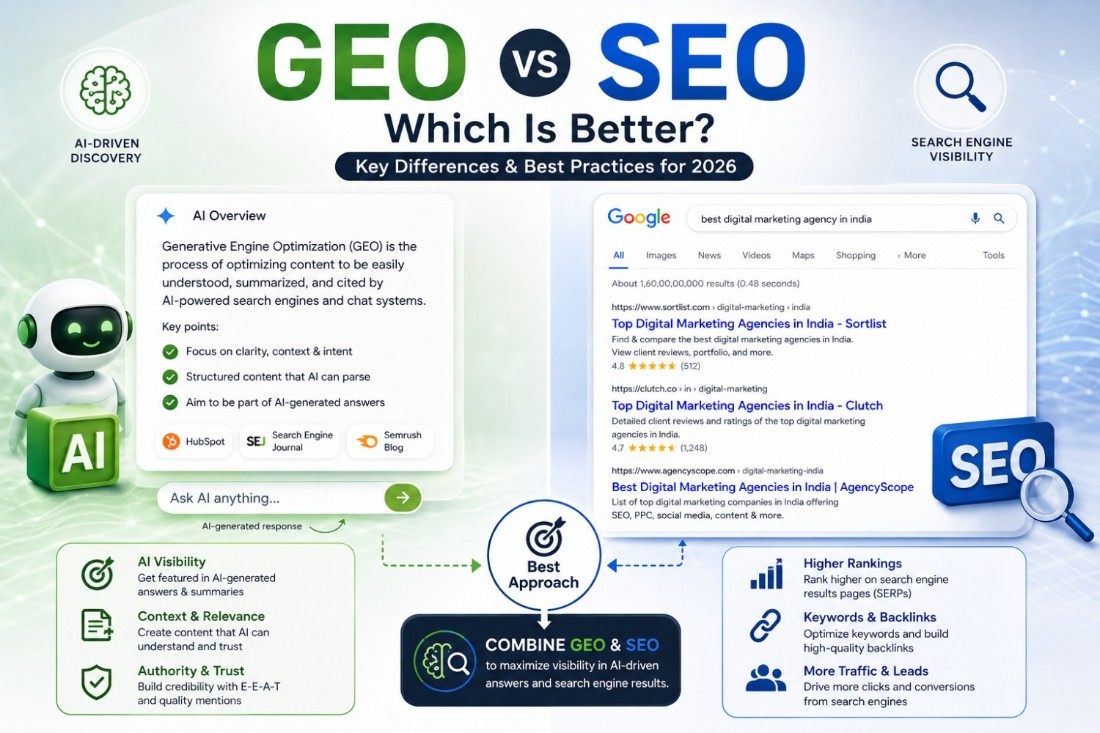
GEO vs SEO is an important comparison for businesses and content creators adapting to the changing search landscape. SEO (Search Engine Optimization) focuses on improving visibility in traditional search engine results, while GEO (Generative Engine Optimization) focuses on making content easier for generative AI systems to understand, retrieve, summarize, and potentially cite in AI-generated responses. SEO can help your website earn visibility through traditional search results, while GEO aims to improve visibility within AI-generated answers from systems such as Google AI Overviews, ChatGPT, Perplexity, and Gemini. In 2026, understanding how SEO and GEO work together is increasingly important as AI-generated answers become a larger part of the search experience.
What Is SEO?

SEO is the long-standing discipline of optimizing a website so it ranks higher in traditional search engine results. It relies on several important factors, including.
- Keyword research and on-page optimization
- Technical health (crawlability, indexability, page speed, mobile-friendliness)
- Backlinks and domain authority
- Content depth and relevance to search intent
- Structured data and clean site architecture
The goal of SEO has always been simple: be the most relevant, trustworthy result for a searcher’s query so Google places you near the top of the results page.
What Is GEO?
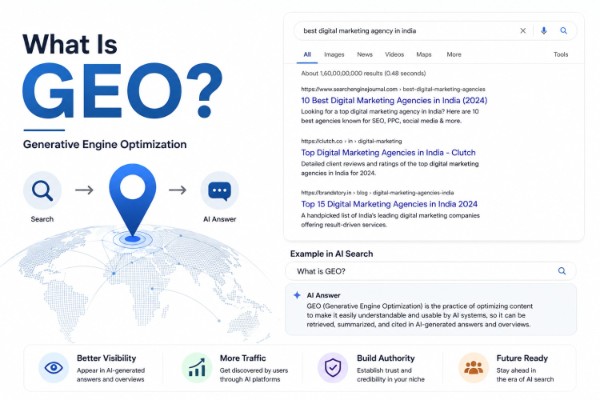
GEO (Generative Engine Optimization) focuses on making content easier for generative AI and AI-powered search systems to discover, understand, retrieve, summarize, and potentially cite in their responses. Instead of focusing only on traditional ranking positions, GEO aims to make content easier for AI systems to understand, retrieve, summarize, and potentially cite.
GEO relies on:
- Clear, extractable answers near the top of the page
- Well-defined facts, statistics, and definitions
- Logical structure (headings, short passages, lists, tables)
- Authoritative, well-sourced, fact-checked content
- Content that AI models can parse without ambiguity
GEO vs SEO Side-by-Side Comparison
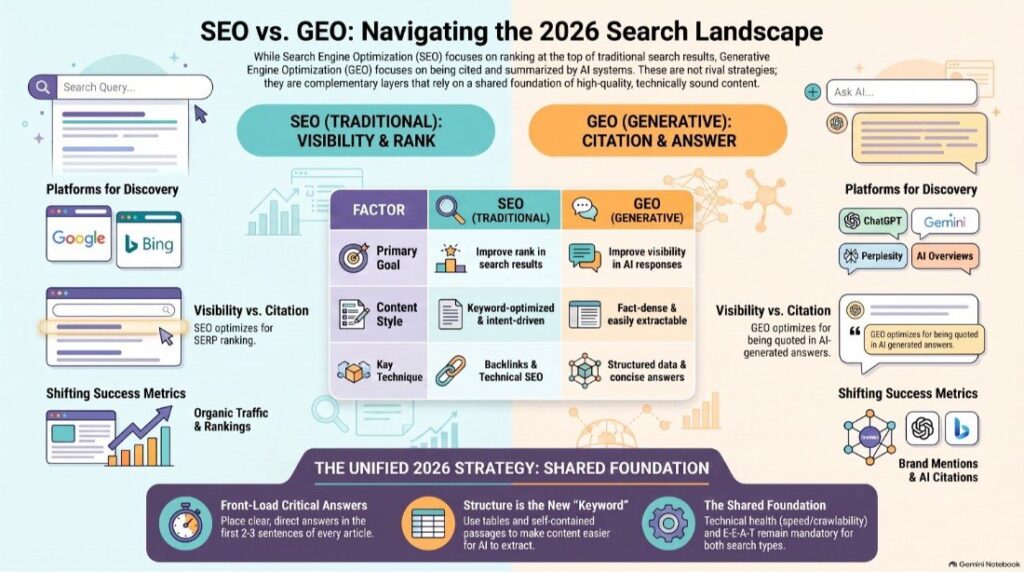
| Factor | SEO | GEO |
|---|---|---|
| Primary goal | Improve visibility in traditional search | Improve visibility in generative AI responses |
| Main platforms | Google, Bing search results | AI Overviews, ChatGPT, Perplexity, Gemini |
| Core success signal | Rankings, impressions, organic traffic | AI mentions, citations, referral traffic, brand visibility |
| Content style | Keyword-optimized, intent-driven | Fact-dense, clearly structured, easily extractable |
| Key techniques | Backlinks, technical SEO, on-page optimization | Clear definitions, structured data, passage-level clarity |
| Measurement | Rank tracking, organic traffic | AI citation tracking, brand mentions in AI answers |
| Content format | Long-form articles, landing pages | Concise answers, FAQs, comparison tables, structured passages |
| Maturity | Established, well-documented practice | Emerging, still evolving |
If you want to compare all three approaches, read our guide to SEO vs AEO vs GEO.
Why This Comparison Matters Right Now
Google AI Overviews can appear when Google determines that a generative AI response is particularly helpful for a query. These experiences provide links to supporting websites, creating another potential path for users to discover content beyond traditional search listings, and AI chat tools are increasingly used as a starting point for research instead of a traditional search engine. This means visibility no longer stops at rank #1. A page that ranks #5 but is written in a clear, extractable way can still be the one an AI Overview quotes while the #1 page gets skipped over. That’s the practical reason SEO and GEO now need to work together rather than as separate strategies.
How GEO and SEO Actually Work Together
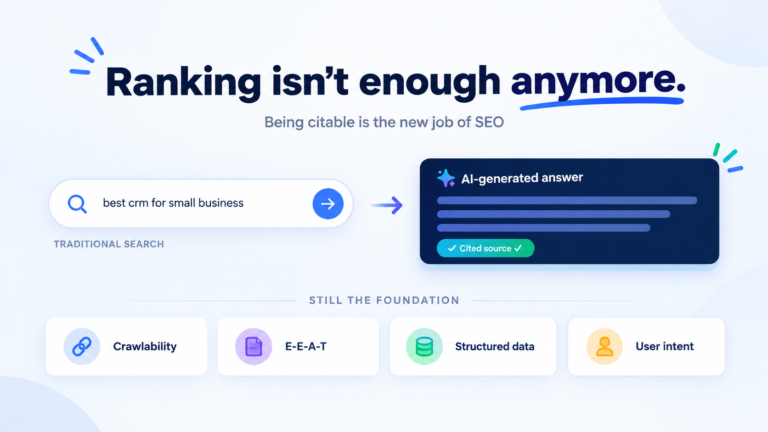
GEO is not a replacement for SEO. The two strategies overlap in important areas, especially content quality, technical accessibility, clear structure, and relevance. Many of the qualities associated with strong SEO such as crawlability, useful content, clear structure, and trustworthy information can also help AI-powered search systems discover and understand your content In practice
- Technical SEO (fast loading, clean structure, indexability) remains important for AI-powered search because pages generally need to be accessible and eligible for search before they can appear as supporting links in Google’s AI features.
If you want to evaluate these technical factors in practice, see our guide to technical SEO audits and best practices. - E-E-A-T (Experience, Expertise, Authoritativeness, Trustworthiness) matters even more for GEO, because Content that demonstrates expertise, accuracy, original insight, and trustworthy sourcing can provide stronger value for both traditional search and AI-powered search experiences.
- Structured, intent-satisfying content created for strong SEO is exactly the kind of content that also performs well in AI Overviews.
In other words, strong SEO fundamentals make GEO possible. GEO simply adds a layer of formatting and clarity on top so AI systems can extract your content more easily.
Practical GEO Optimization Techniques
- Answer the core question in the first 2 3 sentences. This makes the page easier for users and search systems to understand quickly.
- Use clear, standalone definitions. Each key term should be explainable without needing surrounding context.
- Build comparison tables for anything with multiple options or factors. Tables are easy for AI models to extract and summarize.
- Use logical, descriptive headings. This helps both crawlers and AI models understand passage-level context.
- Back claims with data, examples, or named sources. AI systems favor content that demonstrates real expertise, not generic statements.
- Keep passages self-contained. Each section should make sense even if pulled out of the full article.
Practical SEO Techniques That Still Matter
- Thorough keyword and search-intent research
- Original, people-first content with real analysis and insight—not rewritten competitor content. For a deeper look at page-level optimization, see our guide to on-page SEO best practices.
- Clean technical foundation: fast load times, mobile-friendliness, crawlability
- Natural internal linking between related pieces of content
- Authoritative external references, not manipulative link schemes
- Use valid structured data that accurately represents the visible content on the page.
Common Mistakes to Avoid
- Treating GEO as a trick. There’s no shortcut GEO rewards genuinely clear, well-organized, accurate content, not manipulation.
- Ignoring technical SEO because AI doesn’t care about backlinks. AI systems still lean on established trust signals; technical SEO remains the foundation.
- Stuffing content with keywords for old-school SEO. This actively hurts AI extractability and reads as low-value to both users and algorithms.
- Publishing thin or repetitive content just to cover more keywords. Mass-produced, low-value content performs poorly in both traditional rankings and AI citations.
- Forgetting FAQs and follow-up questions. Both SEO and GEO reward content that anticipates related and follow-up questions, not just the primary query.
You can also review these common SEO mistakes to identify issues that can weaken your overall search visibility.
Best Practices for a Combined SEO + GEO Strategy
- Lead every article with a concise, direct answer before going into detail.
For more guidance on creating search-friendly content, see our guide on how to write an SEO-friendly blog post. - Structure content with clear headings, short passages, and comparison tables wherever relevant.
- Demonstrate real experience and expertise practical examples, testing results, and firsthand insight.
- Maintain strong technical SEO: crawlability, indexability, speed, and mobile-friendliness.
- Use accurate, Google-supported structured data (JSON-LD) that matches what’s visibly on the page.
- Cover the topic comprehensively: definitions, benefits, drawbacks, comparisons, mistakes, and FAQs.
Key Takeaways
- SEO optimizes for ranking position on traditional search results.
- GEO optimizes for being cited or summarized inside AI-generated answers.
- GEO and SEO overlap in several important areas, but they are not identical strategies.
- Clear, front-loaded answers, structured content, and genuine expertise benefit both.
- Avoid shortcuts: mass-produced or keyword-stuffed content underperforms in both SEO and GEO.
If you’re still evaluating the role of SEO in your overall digital strategy, see our guide on how important SEO is to the success of a website.
Ready to Test Your SEO Knowledge?
Take our free SEO quiz and see how much you really know.
Conclusion
GEO and SEO aren’t rival strategies; they address different aspects of search visibility while sharing many of the same fundamentals getting genuinely useful, trustworthy content in front of people, whether they find it through a traditional search result or an AI-generated answer. The safest long-term approach is to keep building content that’s accurate, well-structured, and written primarily for people. That foundation already satisfies most of what both search engines and AI systems are looking for.
Frequently Asked Questions
1. Is GEO replacing SEO?
No. GEO builds on top of SEO fundamentals. Strong technical SEO, useful content, clear structure, and trustworthy information can support visibility across both traditional search and AI-powered search experiences. However, no SEO or GEO technique guarantees an AI citation.
2. Is GEO replacing SEO?
No. GEO builds on top of SEO fundamentals. Strong technical SEO and E-E-A-T are still required for a page to be trusted and cited by AI systems.
3. Do I need a separate content strategy for GEO?
Not necessarily a separate one but you do need to adjust formatting: clearer answers up top, more structured passages, and stronger use of tables and definitions.
4. Can small websites compete in GEO the same way they compete in SEO?
Yes, potentially more easily. Small websites can potentially gain visibility in AI-generated answers when they provide highly relevant, trustworthy, and clearly structured information. However, there is no guarantee that smaller sites will consistently outperform more established sources though authority and trust signals still matter.
5. How do I measure GEO performance?
Track brand and content mentions inside AI Overviews and AI chat tools, alongside traditional metrics like rankings and organic traffic.