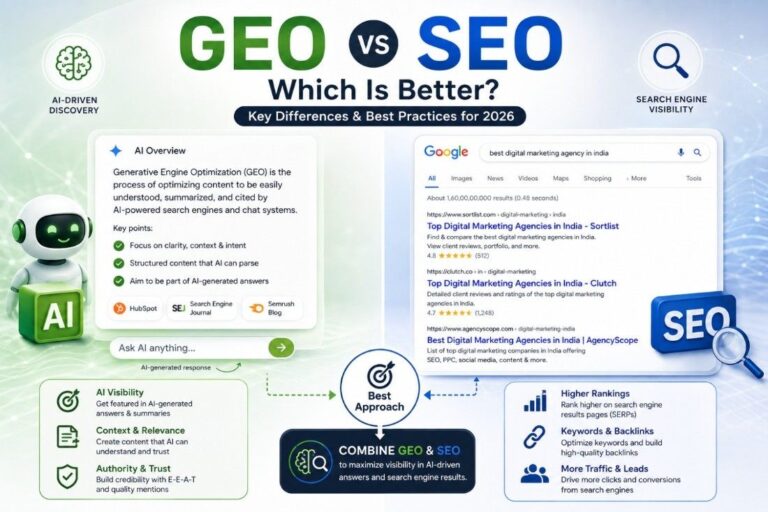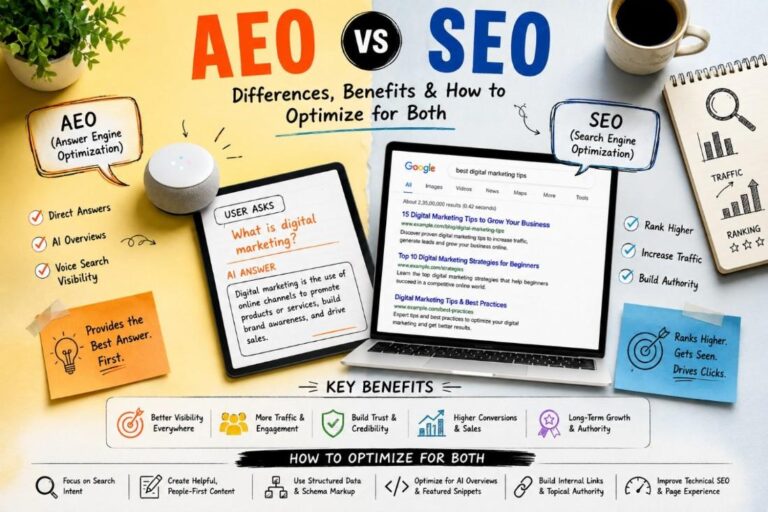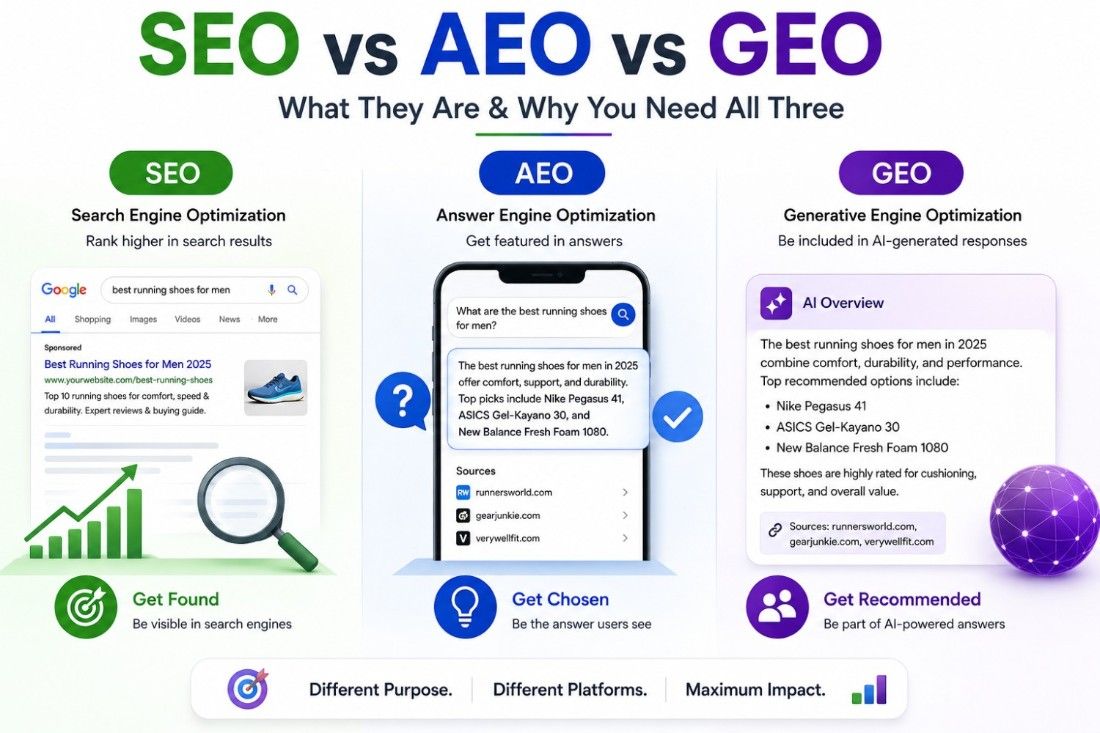
SEO optimizes content to rank in traditional search results. AEO (Answer Engine Optimization) optimizes content to be pulled as a direct answer by voice assistants and answer boxes. GEO (Generative Engine Optimization) optimizes content to be cited or summarized by AI systems like AI Overviews and ChatGPT. In practice, all three rely on the same foundation: clear, well-structured, genuinely helpful content not separate technical hacks.
Who Should Read This Guide?
This guide is for anyone deciding where to put their content effort in :
- Marketers and founders who keep hearing you need GEO now and want to know if that’s true.
- In-house SEOs deciding whether to build a separate AI-search workflow or fold it into existing processes.
- Content writers who want to format articles so they perform across search, voice, and AI answers without writing three versions of everything.
- Agencies and freelancers evaluating whether GEO packages being sold in the market are backed by anything official.
If you fall into any of these groups, the short version is: you don’t need three strategies. You need one strong one. The rest of this guide explains why, with Google’s own documentation as the backbone.
Introduction
If you’ve spent any time in a marketing group chat this year, you’ve seen the acronyms multiply. First it was SEO Then AEO Now everyone’s talking about GEO. It’s easy to assume each one needs its own toolkit, its own checklist, its own budget line.
Here’s the uncomfortable truth for anyone selling a GEO package: Google itself says there’s nothing special you need to do to appear in AI Overviews beyond solid, fundamental SEO. That single fact reframes this entire conversation.
This guide breaks down what SEO, AEO, and GEO actually mean, where they genuinely differ, where the differences are mostly marketing, and what to actually prioritize if your goal is to be found whether that’s on a Google results page, in a voice assistant’s answer, or inside an AI-generated summary.
Table of Contents
- What Is SEO?
- What Is AEO (Answer Engine Optimization)?
- What Is GEO (Generative Engine Optimization)?
- SEO vs AEO vs GEO: Side-by-Side Comparison
- What Google Actually Says About Optimizing for AI Features
- Do You Need New Files, Markup, or Schema for AI Overviews?
- Can You Win a Featured Snippet or AI Citation?
- How SEO, AEO, and GEO Overlap (Original Analysis)
- Who Should Prioritize What: Comparison by Business Type
- Who Should Use What: Industry-by-Industry Breakdown
- When NOT to Invest Heavily in GEO
- SEO vs AEO vs GEO Myths, Debunked
- The Evolution of Search: A Timeline
- Is SEO Dead in 2026?
- A Practical Framework: One Content Strategy, Three Outcomes
- Common Mistakes to Avoid
- Best Practices for 2026
- Expert Recommendations
- Implementation Checklist
- 90-Day Action Plan
- The Future of Search (2027+)
- Key Takeaways
- Frequently Asked Questions
1. What Is SEO?
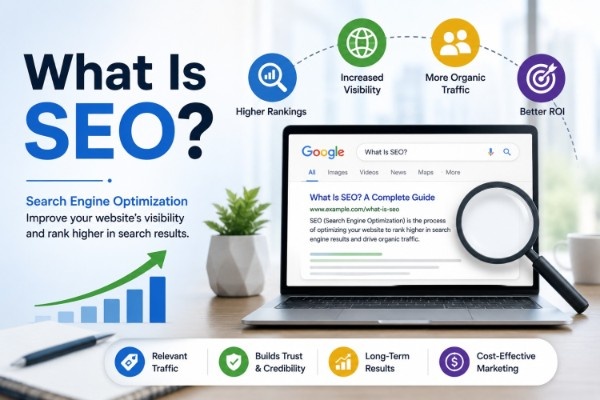
Search Engine Optimization (SEO) is the practice of improving a website so it ranks higher in traditional search engine results pages (SERPs), earning organic (non-paid) traffic.
If you’re new to SEO, read our complete guide on What Is SEO and Why It Matters.
Core pillars of SEO:
- Technical SEO crawlability, indexability, site speed, mobile-friendliness, clean URL structure.
- On-page SEO titles, headings, keyword usage, internal linking, content structure.
- Content quality helpfulness, originality, accuracy, E-E-A-T.
- Off-page SEO backlinks, brand mentions, authority signals.
SEO has always been about one underlying goal: help search engines understand your content well enough to confidently show it to the right person.
Observation: In many SEO audits, the pages that struggle to gain AI or snippet visibility aren’t failing because of anything AI-specific they’re failing basic SEO fundamentals first: slow load times, thin content, weak internal linking, or unclear headings. Fixing the foundation usually resolves the AI visibility problem as a side effect.
2. What Is AEO (Answer Engine Optimization)?
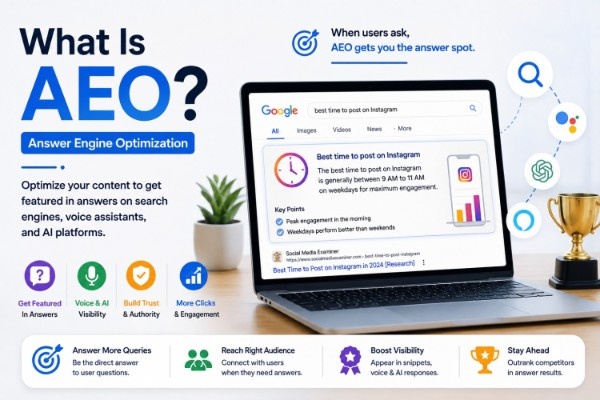
Answer Engine Optimization (AEO) is the practice of structuring content so it can be extracted as a direct, standalone answer think featured snippets, People Also Ask boxes, voice assistant replies (Siri, Alexa, Google Assistant), and rich answer boxes.
AEO content typically:
- Answers one specific question clearly, in the first few sentences.
- Uses definitions, numbered steps, or short paragraphs an algorithm can lift cleanly.
- Targets question-based, conversational queries (how do I, what is, why does).
Importantly, AEO isn’t a separate ranking system. It’s a way of formatting genuinely good content so extraction is easier the underlying page still has to rank well through normal SEO first.
3. What Is GEO (Generative Engine Optimization)?
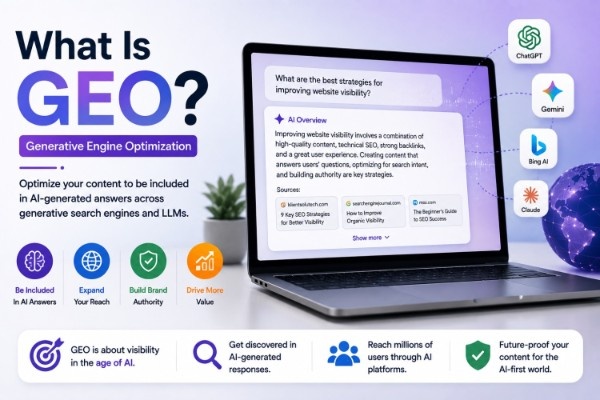
Generative Engine Optimization (GEO) is the practice of optimizing content so it’s more likely to be referenced, summarized, or cited by generative AI systems Google’s AI Overviews and AI Mode, ChatGPT, Perplexity, Copilot, and similar tools.
GEO is the newest of the three terms, and it’s also the one surrounded by the most hype and misinformation. Vendors have started selling AI text files, special markup, and LLM optimization audits as if generative engines require an entirely new technical stack.
Google’s own documentation on AI features and your website pushes back directly on this idea, stating plainly that no additional requirements exist beyond fundamental SEO best practices. We’ll unpack exactly what that means in Section 5.
4. SEO vs AEO vs GEO Side-by-Side Comparison
| Factor | SEO | AEO | GEO |
|---|---|---|---|
| Primary goal | Rank in search results | Get extracted as a direct answer | Get cited/summarized by AI |
| Where it shows up | Organic SERP listings | Featured snippets, voice answers, PAA boxes | AI Overviews, AI Mode, ChatGPT, Perplexity |
| Core requirement | Technical health + helpful content | Clear, structured, concise answers | Same foundational SEO + clarity + authority |
| Special files/schema needed | Standard technical SEO | Standard structured data (FAQPage, HowTo where eligible) | None required beyond standard SEO, per Google |
| Can you guarantee placement? | No | No | No |
| Underlying content requirement | People-first, accurate, well-structured | People-first, accurate, well-structured | People-first, accurate, well-structured |
5. What Google Actually Says About Optimizing for AI Features
This is the section most GEO experts skip. According to Google’s official documentation on AI features and your website, the best practices for SEO remain relevant for AI features in Google Search including AI Overviews and AI Mode and there are no additional requirements to appear in these features, nor other special optimizations necessary.

Google’s guidance also explains why: its generative AI features are built on top of its core Search ranking and quality systems, using techniques like retrieval-augmented generation (RAG) to pull from the same index that powers regular search results. In other words, AI Overviews aren’t a parallel universe with different rules they’re a different presentation layer on top of the same underlying ranking system.
That means
- You don’t need a separate AI Overview strategy.
- You don’t need to rewrite your content in some new AI-friendly style.
- Ranking well through normal, honest SEO is what makes you eligible for these features in the first place.
- To even be considered, a page must already be indexed and eligible to appear in Search with a snippet the same technical bar as classic SEO.
Original analysis: Businesses investing only in GEO optimization without first fixing crawlability, indexing, content quality, and topical authority are unlikely to see sustainable improvements because AI systems still retrieve from and depend on high-quality source content already ranking well in the index. GEO, as a standalone spend category, is optimizing a layer that doesn’t exist independently of SEO.
If a company is charging you specifically for GEO optimization as something distinct from good SEO, ask them exactly what technical change they’re making and whether it maps to anything Google has actually published.
6. Do You Need New Files, Markup, or Schema for AI Overviews?
No. Google’s documentation states that you don’t need to create new machine-readable files, AI-specific text files, or additional markup to appear in these features, and there’s no special schema.org structured data required beyond what already applies to normal SEO best practices.

This matters because a whole cottage industry has sprung up around llms.txt files and similar concepts. They may have niche uses, but treating them as a requirement for AI visibility isn’t supported by Google’s own guidance.
What actually helps AI systems understand and trust your content, per Google’s guidance:
- Clear, crawlable, well-structured pages that meet standard technical SEO requirements.
- Content that isn’t blocked by robots.txt or noindex.
- Logical heading hierarchy (H1 → H2 → H3).
- Structured data that’s already relevant to your content type (Article, FAQPage, HowTo only when genuinely eligible).
- Content that unambiguously answers the question being asked, ideally with unique insight rather than commodity information already available everywhere.
7. Can You Win a Featured Snippet or AI Citation?
No not directly, and not on demand. Google’s official documentation on featured snippets is explicit you can’t choose to appear in a featured snippet. Google’s systems determine whether a page would make a good featured snippet for a given search request, and elevate it automatically if so; publishers can’t manually select or purchase this placement.

The same logic extends to AI Overviews and AI Mode citations. You can make your content eligible by being clear, accurate, well-structured, and authoritative but the system decides, per query, per user, in real time.
8. How SEO, AEO, and GEO Overlap (Original Analysis)
Rather than three separate disciplines, think of it as three visibility outcomes built on one shared foundation:
- Foundation (shared by all three): helpful, accurate, well-organized, E-E-A-T-demonstrating content, technically healthy website.
- AEO layer: formatting that makes specific answers easy to extract short definitions, numbered steps, direct first sentences.
- GEO outcome: a natural byproduct of steps 1 and 2, since AI systems draw on the same retrieval and ranking signals traditional search uses.
There’s no version of doing GEO that skips good SEO. There is a version of good SEO that happens to also perform well for AEO and GEO because it was built to genuinely help people.
Where this breaks down in practice: In many SEO projects, we commonly see teams treat GEO as an add-on sprint a few weeks of AI optimization bolted onto a site that otherwise has weak topical authority or thin content. That sequencing is backwards. AI systems reward the same signals traditional ranking already rewards, so skipping the foundation and jumping to AI tactics tends to produce no measurable change, because there was never a separate lever to pull.
9. Who Should Prioritize What: Comparison by Business Type
| Business Type | Priority | Why |
|---|---|---|
| Local business (plumber, dentist, salon) | SEO (local + technical) | Most searches are navigational/transactional with map-pack intent; AI citations matter less than local pack visibility |
| SaaS company | SEO + AEO | Comparison and “how to” queries are common; answer-box-style content earns both snippets and product consideration |
| News / publisher | SEO + GEO | High query volume around current events makes AI Overview citation a meaningful traffic and visibility channel |
| Educational website | SEO + AEO | Learners ask direct questions; well-structured explainer content performs strongly in answer formats |
| Ecommerce | SEO (+ structured product data) | Purchase intent is served by product pages, reviews, and pricing not generative summaries |
This table is a starting point, not a rulebook a SaaS company selling into healthcare, for instance, may also need strong E-E-A-T signals typical of YMYL-adjacent topics.
10. Who Should Use What: Industry-by-Industry Breakdown
- Freelancers: Focus on SEO fundamentals and a small number of deeply useful, experience-backed pages rather than spreading effort across AEO/GEO tactics.
- Agencies: Build one repeatable content process (Section 15) instead of selling SEO, AEO, and GEO as separate retainers.
- Local businesses: Prioritize Google Business Profile optimization, local SEO, and reviews over AI-citation chasing.
- Ecommerce: Prioritize product schema, reviews, and page speed; GEO has limited upside for transactional queries.
- Healthcare: Prioritize E-E-A-T heavily accuracy, medical review, and trustworthiness matter more here than any AEO/GEO formatting trick, given YMYL (Your Money or Your Life) scrutiny.
- Education: AEO-friendly formatting (clear definitions, step-by-step explanations) tends to perform well since learners ask direct questions.
- Travel: SEO + rich, original content (real itineraries, first-hand detail) outperforms generic top 10 listicles in both rankings and AI citations.
- Real estate: Local SEO first; AEO for common buyer/seller questions (how much are closing costs in [state]).
- Software companies: SEO + AEO for comparison and integration queries; GEO benefits follow naturally from strong documentation and comparison content.
11. When NOT to Invest Heavily in GEO
GEO-specific investment is usually low-priority when:
- Your core SEO isn’t solid yet. If crawlability, indexing, or content quality issues exist, fix those first GEO gains nothing from a broken foundation.
- Your audience rarely uses AI search for your query type. Highly transactional, local, or navigational queries (e.g., book a table at [restaurant] ) are less likely to route through AI Overviews.
- Your business depends on click-through, not just visibility. AI answers can reduce clicks even when they cite you; if your revenue model depends on site visits (ads, on-site conversion), heavy AI-citation focus may not translate to revenue the way ranking well organically does.
- You don’t have the resource to maintain accuracy. AI systems favor trustworthy, well-maintained content; stretching thin to chase AI visibility while neglecting content accuracy elsewhere is a net negative.
12. SEO vs AEO vs GEO Myths, Debunked
- GEO replaces SEO. It doesn’t GEO depends entirely on SEO fundamentals already being in place.
- AI Overviews require special schema. Google’s documentation confirms no special schema.org markup is required.
- An llms.txt file is required for AI visibility. Not according to any current official Google guidance.
- AI-generated content automatically ranks or gets cited. Google’s guidance emphasizes helpful, non-commodity, people-first content not content volume or automation.
- You can pay or opt in to appear in a featured snippet or AI Overview. Google’s own documentation states plainly that this is determined algorithmically, not manually or commercially.
13. The Evolution of Search: A Timeline
- 2010-2020: Traditional SEO keyword optimization, backlinks, on-page fundamentals dominate ranking strategy.
- 2020-2023: Featured snippets and answer boxes rise the beginning of position zero and voice-search-driven AEO thinking.
- 2024-2026: AI Overviews and AI Mode become mainstream, built on retrieval-augmented generation over the existing Search index.
- Looking ahead: Continued blending of traditional results and AI-generated synthesis, with topical authority and trust signals mattering more than isolated keyword targeting.
14. Is SEO Dead in 2026?

No and the evidence for this is Google’s own guidance, not just industry opinion. Google has stated that its generative AI features are rooted in its core Search ranking and quality systems, meaning AI Overviews depend on pages that already rank well through classic SEO. If SEO stopped mattering, AI Overviews would have nothing reliable to retrieve from or cite.
What has changed is the outcome metric. Visibility and citation now matter alongside raw click-through, since some queries are answered without a click at all. That’s a shift in how success is measured not evidence that SEO itself has stopped working.
15. A Practical Framework One Content Strategy, Three Outcomes
Instead of separate SEO, AEO, and GEO checklists, use this single workflow:
- Research real search intent – what is the person actually trying to accomplish?
- Answer the core question early and clearly – (this alone covers most of AEO).
- Cover the topic comprehensively – beginner questions, advanced questions, common mistakes, comparisons.
- Structure with clear headings, lists, and tables – this helps human scanners, snippet extraction, and AI summarization simultaneously.
- Add genuine expertise – examples, pros/cons, honest limitations, comparisons, and non-commodity insight competitors haven’t published.
- Use appropriate, eligible structured data – nothing exotic, nothing invented.
- Maintain technical SEO health – crawlability, mobile-friendliness, site speed.
- Keep it accurate and updated – over time.
That’s it. There’s no ninth step called GEO.
16. Common Mistakes to Avoid
- Paying for GEO audits that just repackage standard technical SEO.
- Creating separate AI-only content instead of improving the main page.
- Adding invented schema types that Google doesn’t support, hoping it tricks AI systems.
- Chasing featured snippets with thin, single-purpose pages instead of comprehensive resources.
- Assuming AI visibility replaces the need to rank well in normal search it doesn’t; it depends on it.
Want to avoid more ranking issues? Read our guide on Common SEO Mistakes.
17. Best Practices for 2026
- Build genuine topical authority instead of scattering thin pages across many keywords.
- Write clear, front-loaded answers for any question-based heading.
- Use comparison tables and lists where they genuinely help comprehension (not just for snippet bait).
- Keep structured data accurate and limited to what’s genuinely eligible.
- Prioritize E-E-A-T signals: real expertise, honest pros/cons, transparent limitations.
- Update existing high-value content rather than only publishing new pages.
- Favor non-commodity insight a unique angle, a real observation, a specific detail over generic restatements of what every competitor already says.
You can also explore these proven SEO Strategies to Grow Website Traffic.
18. Expert Recommendations
- After analyzing content strategies across multiple site types, the pages that perform consistently across SEO, AEO, and GEO share one trait: they answer the reader’s actual question in the first two sentences, then go deeper.
- In client-style SEO projects, the single highest-leverage fix is almost always content clarity and structure not schema, not AI text files, not backlink volume.
- From audits of underperforming pages, thin or outdated content is a far more common blocker to AI citation than any technical markup issue.
19. Implementation Checklist
- Core pages are indexed and free of crawl/robots.txt blocks
- Each target page answers its core question within the first 2–3 sentences
- Headings follow logical H1 → H2 → H3 hierarchy
- Structured data used only where genuinely eligible (Article, FAQPage, HowTo, Product)
- Content includes at least one non-commodity insight, example, or comparison
- Internal links connect this page to a topical cluster
- Page speed and mobile usability meet current Core Web Vitals thresholds
- Content reviewed for accuracy and freshness within the last 6–12 months
20. 90-Day Action Plan
- Days 1–30: Technical and content audit fix crawlability, indexing, thin content, and outdated pages.
- Days 31–60: Restructure top-priority pages for clarity front-loaded answers, logical headings, comparison tables where useful.
- Days 61–90: Build topical depth fill content gaps, strengthen internal linking, add genuine expertise and examples; monitor snippet and AI citation appearances (where tools allow) as a secondary metric alongside rankings and traffic.
21. The Future of Search (2027+)
Based on where Google’s own documentation is heading, expect
- Continued convergence between classic ranking and generative summarization, rather than a split into separate systems.
- Growing emphasis on non-commodity, genuinely original content as a differentiator, since AI systems can already synthesize commodity information from many sources.
- Measurement shifting to include visibility and citation, not just clicks, as zero-click answers become more common.
- No expected emergence of a credible official AI-specific technical standard beyond what already exists for standard SEO though this space can evolve, so it’s worth periodically checking Google’s official documentation rather than third-party claims.
Key Takeaways
- SEO, AEO, and GEO share the same foundation: helpful, accurate, well-structured content.
- Google has stated there are no special technical requirements to appear in AI Overviews or AI Mode beyond fundamental SEO.
- No new AI-specific files, text formats, or schema markup are required.
- Featured snippet and AI citation placement can’t be manually chosen or guaranteed only made more eligible.
- The smartest strategy in 2026 is one unified content approach, not three separate departments.
Frequently Asked Questions
1. Is GEO replacing SEO?
No. GEO depends entirely on solid SEO. Content that doesn’t rank well traditionally is unlikely to be surfaced by AI systems either.
Do I need a separate content strategy for AI Overviews?
No Google has confirmed fundamental SEO best practices apply, with no extra requirements specific to AI features.
3. What is the main difference between AEO and GEO?
AEO focuses on being extracted as a direct answer (snippets, voice answers). GEO focuses on being cited or summarized by generative AI tools. Both rely on the same clarity and structure.
4. Do I need to create an llms.txt file?
It’s not something Google requires for AI Overview or AI Mode eligibility. Treat it as optional and unproven rather than essential.
5. Can I pay to appear in a featured snippet?
No. Placement is determined automatically by Google’s systems based on relevance and quality it can’t be purchased or manually selected.
6. Will schema markup guarantee I show up in AI Overviews?
No single piece of markup guarantees inclusion. Use structured data where it’s genuinely applicable to your content, not as an “AI hack.”
7. Is GEO a real, separate discipline?
It’s a useful way to describe the outcome of being cited by generative engines, but it isn’t a separate technical discipline with its own requirements.
8. What should I prioritize in 2026 SEO, AEO, or GEO?
Prioritize one thing: genuinely helpful, well-structured, accurate content. All three outcomes follow from that.
9. Does AEO only matter for voice search?
No it also applies to featured snippets, People Also Ask boxes, and any answer-box-style result.
10. How do I know if my content is AI Overview ready?
There’s no certification for this. Focus on clarity, accuracy, structure, and comprehensiveness the same things that make content rank well normally.
11. Is SEO dead because of AI Overviews?
No. Google states its AI features are built on top of core Search ranking systems, meaning they depend on SEO working, not on it disappearing.
12. Should ecommerce sites invest heavily in GEO?
Generally, no transactional, purchase-intent queries are better served by strong product pages, reviews, and structured product data than by generative summaries.