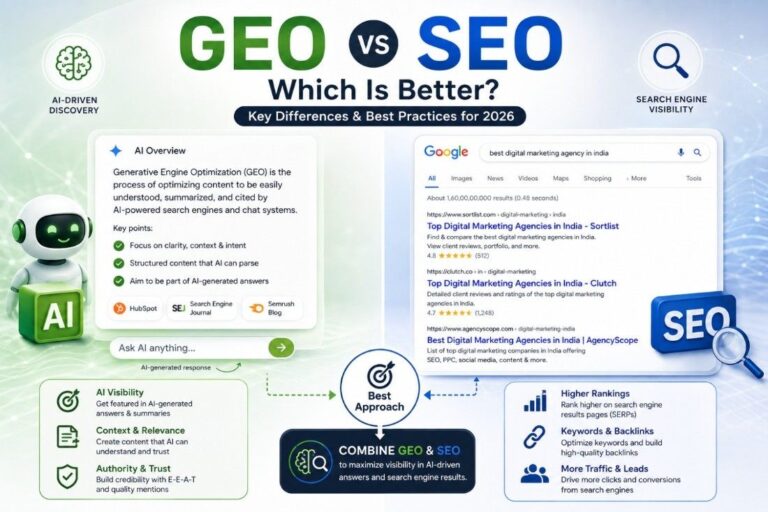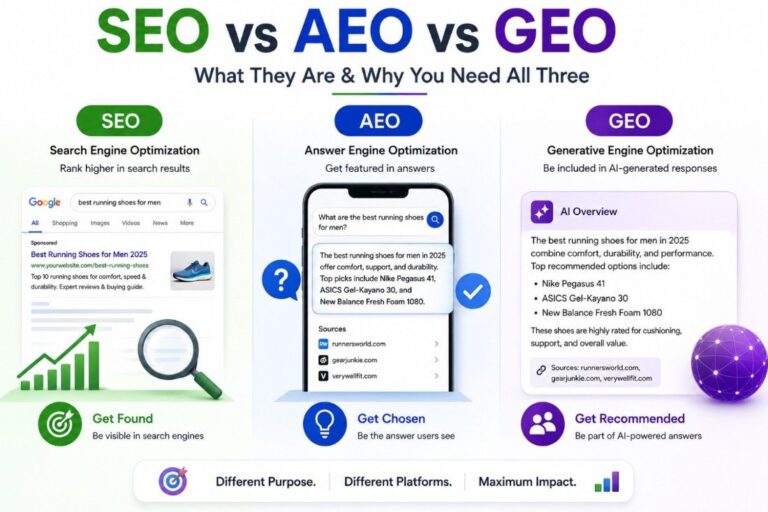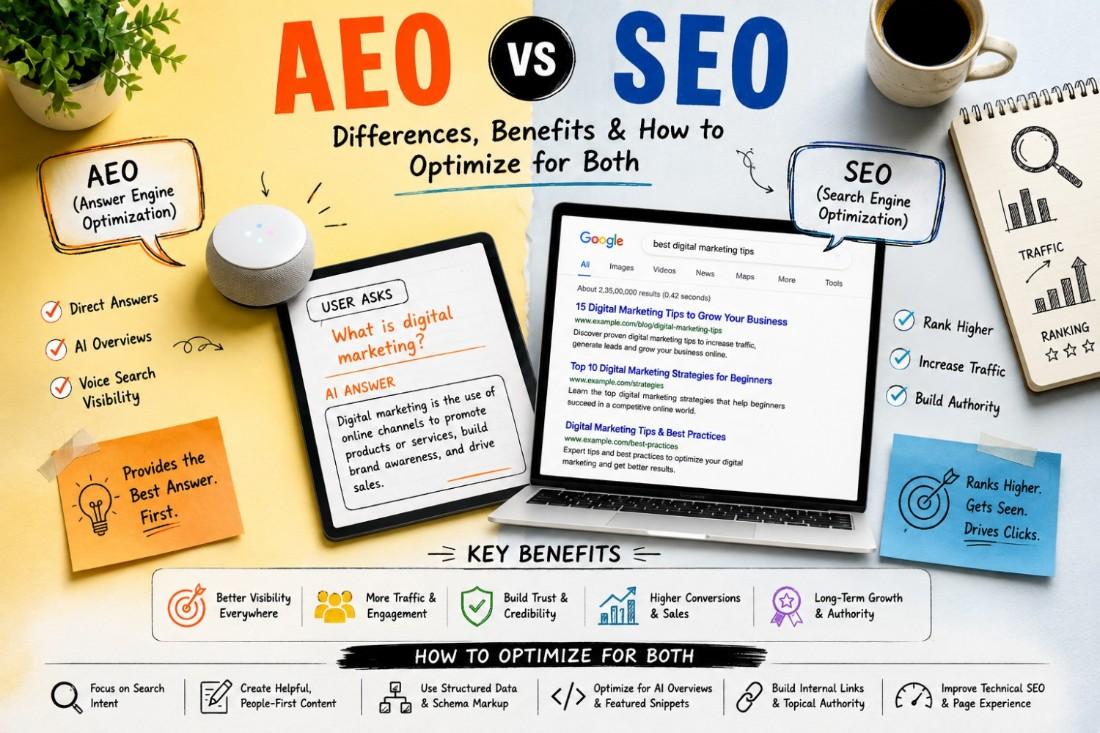
SEO (Search Engine Optimization) focuses on ranking web pages higher in traditional search engine results like Google’s blue links. AEO (Answer Engine Optimization) focuses on getting your content selected, quoted, or summarized by AI-driven answer systems like Google AI Overviews, ChatGPT, Perplexity, and voice assistants. SEO aims for clicks; AEO aims for direct answers. In 2026, the strongest content strategies combine both, because Google itself now blends traditional rankings with AI-generated summaries on the same results page.
Table of Contents
- What Is SEO?
- What Is AEO?
- AEO vs SEO: Key Differences
- Why AEO Has Become Important
- Benefits and Drawbacks of Each Approach
- How to Optimize for Both SEO and AEO
- Common Mistakes to Avoid
- Best Practices Checklist
- Frequently Asked Questions
- Key Takeaways
What Is SEO?
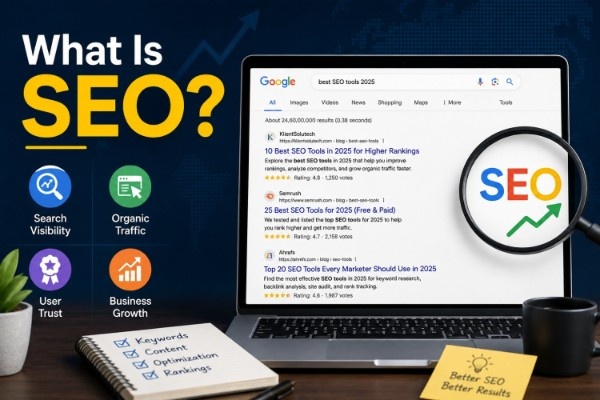
Search Engine Optimization is the practice of improving a website so it ranks higher in organic (non-paid) search engine results. Traditional SEO revolves around three pillars.
- On-page SEO – content quality, keyword usage, headings, internal linking, and metadata.
- Technical SEO – crawlability, indexability, site speed, mobile-friendliness, and structured data.
- Off-page SEO – backlinks, brand mentions, and authoritativeness signals.
The end goal of SEO is simple: rank a page on the first page of search results and earn a click from the user.
For Google’s own explanation of SEO fundamentals, see the SEO Starter Guide.
What Is AEO?
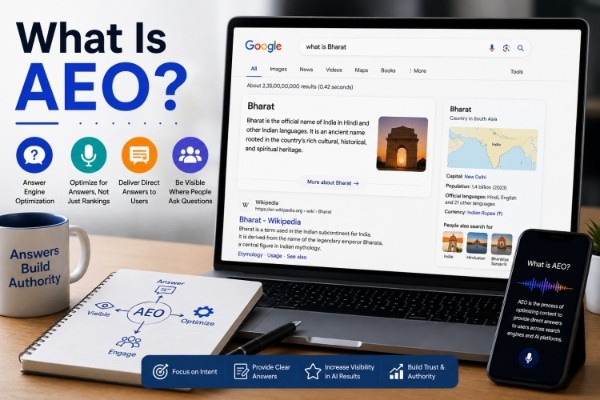
Answer Engine Optimization is a newer discipline built around one core idea: instead of sending a user to a webpage, the search system answers the question directly, often pulling that answer from a specific webpage as its source. AEO applies to:
- Google AI Overviews (the AI-generated summary shown above traditional results)
- Featured snippets and People Also Ask boxes
- AI chat tools like ChatGPT, Perplexity, and Gemini
- Voice assistants such as Google Assistant, Siri, and Alexa
AEO-style content emphasizes clear, direct, well-structured answers that make information easier for users and search systems to understand.
AEO vs SEO Key Differences
| Factor | SEO | AEO |
|---|---|---|
| Primary Goal | Rank the page and earn a click | Get selected/quoted as the answer source |
| Success Metric | Organic rankings, click-through rate, traffic | Answer visibility, citation frequency, brand mentions in AI responses |
| Content Style | Long-form, keyword-optimized, link-driven | Concise, direct, definition-first, structured for extraction |
| Ideal Format | Blog posts, landing pages, pillar content | Short answers, definitions, FAQs, comparison tables, numbered steps |
| Where It Shows Up | Traditional blue-link search results | AI Overviews, chatbots, voice assistants, snippet boxes |
| Traffic Behavior | Sends users to your site | May answer the query without a click (“zero-click”) |
| Core Requirement | Backlinks, technical health, keyword relevance | Clarity, structured data, trustworthy and well-organized facts |
The most important distinction SEO competes for a ranking position; AEO competes to become the answer itself. A page can rank #1 in traditional SEO but still be ignored by an AI Overview if the answer isn’t clearly extractable and vice versa.
If you want to understand how SEO, AEO, and GEO differ and work together, see our complete guide to SEO vs AEO vs GEO.
Why AEO Has Become Important
Search behavior has shifted. Many users now get their answer directly on the results page or inside a chat interface, without visiting any website. This changes what ranking well means. A page that used to earn clicks purely by ranking #3 might now get zero clicks if an AI Overview already answered the question unless that AI Overview is citing that same page as its source, which still builds brand visibility and trust even without a click.
Google states that the same foundational SEO best practices apply to AI features such as AI Overviews and AI Mode, with no additional optimization requirements. Google’s AI features documentation
Benefits and Drawbacks of Each Approach
SEO
Benefits:
- Drives consistent, measurable organic traffic
- Well-understood, mature discipline with established tools (Search Console, analytics)
- Builds long-term domain authority
Drawbacks:
- Slower results; competitive keywords can take months to rank
- Increasingly affected by zero-click searches and AI Overviews reducing click-through
- Requires ongoing technical maintenance
AEO
Benefits:
- Builds visibility even in zero-click environments
- Positions a brand as an authoritative, trusted source inside AI tools
- Rewards genuinely clear, well-structured, expert content
Drawbacks:
- Harder to measure directly (few standardized AEO analytics tools exist yet)
- No guaranteed placement AI systems select sources algorithmically
- Being the cited source doesn’t always translate into a website visit
How to Optimize for Both SEO and AEO
- Lead with a direct answer. Place a concise, accurate answer to the main query within the first 1-2 sentences of the section, then expand with detail. This helps both featured snippets and AI Overviews.
- Use clear, logical heading hierarchy (H1 → H2 → H3). This helps search engines and AI systems parse the structure of your content.
- Use comparison tables when they genuinely help users understand differences between options.
- Write genuine, first-hand insight. Google’s E-E-A-T (Experience, Expertise, Authoritativeness, Trustworthiness) guidelines apply to both SEO and AEO AI systems are trained to prefer content that demonstrates real expertise, not rehashed information.
- Implement structured data (JSON-LD). Schema types like
FAQPage,HowTo, andArticlehelp both traditional and AI-driven systems understand your content’s intent but only add schema that genuinely matches your visible content. - Build topical depth with internal links. Connect related articles into a pillar-and-cluster structure so both search engines and AI crawlers understand the full scope of your expertise on a topic.
- Keep technical SEO solid. Fast load times, mobile-friendliness, and clean crawlability remain foundational AI answer engines still rely on the same crawled index that traditional search uses.
These fundamentals align with Google’s Search Essentials, which cover technical requirements, spam policies, and key SEO best practices. Google Search Essentials
Common Mistakes to Avoid
- Writing only for keyword density instead of genuine search intent. Avoiding common SEO mistakes is also important when optimizing content for both traditional and AI-driven search.
- Burying the direct answer deep inside long paragraphs
- Ignoring structured data or using schema that doesn’t match the page content
- Treating AEO as a trick rather than a natural extension of clear, well-organized writing
- Copying competitor content instead of adding original analysis, examples, or testing results
- Assuming a high SEO ranking automatically guarantees AEO visibility
Best Practices Checklist
- Answer the core question within the first few sentences
- Use descriptive H2/H3 headings that mirror real user questions
- Include at least one comparison table where relevant
- Add a short FAQ section using real, commonly asked questions
- Support claims with examples, data, or first-hand observations
- Use valid, Google-supported JSON-LD schema
- Keep URL slugs, meta titles, and meta descriptions honest and descriptive (avoid clickbait)
- Optimize images with descriptive filenames and concise ALT text (under 125 characters)
Key Takeaways
- SEO optimizes for ranking position and clicks; AEO optimizes for being selected as the direct answer.
- Both rely on the same foundation: accurate, well-structured, genuinely expert content.
- Concise answers, comparison tables, FAQs, and clean schema markup help with both simultaneously.
- Neither approach should involve keyword stuffing, thin content, or manipulative tactics — Google’s guidelines penalize both equally.
- The most future-proof strategy treats AEO as a natural extension of strong SEO, not a separate shortcut.
Frequently Asked Questions
1. Does AEO replace SEO?
No. AEO builds on top of SEO fundamentals. A page still needs solid technical SEO, crawlability, and authority signals before it has a real chance of being selected as an AI answer source.
2. Can I track AEO performance the way I track SEO?
Not as precisely yet. There’s no universal AEO analytics dashboard equivalent to Google Search Console, though some tools are beginning to track brand mentions and citations inside AI Overviews and chatbot responses.
3. Do featured snippets count as AEO?
Yes. Featured snippets, People Also Ask boxes, and voice assistant answers are earlier forms of the same underlying goal AEO targets: becoming the direct, extractable answer to a query.
4. Is AEO only relevant for Google?
No. AEO applies to any answer-generating system, including ChatGPT, Perplexity, Gemini, and voice assistants not just Google’s AI Overviews.