Types of keywords in SEO are categories of search terms grouped by what a person wants to accomplish in Google Search. The main types include informational, navigational, commercial, and transactional keywords. Understanding the intent behind each type helps you choose the right keywords and create content that matches what searchers actually need.
If you want to learn how to research and select keywords for an SEO campaign, see our keyword research guide.
Table of Contents
- What Are Keywords in SEO?
- Why Keyword Intent Matters
- The 4 Main Types of Keywords in SEO
- Types of Keywords by Length
- Types of Keywords by Search Intent, Length, and Funnel Stage
- How to Choose the Right Keyword Type
- Common Keyword Mistakes to Avoid
- Real-World Keyword Examples
- Frequently Asked Questions
What Are the Main Types of Keywords in SEO?
The four main keyword types based on search intent are informational, navigational, commercial, and transactional. Informational keywords help users learn, navigational keywords help them find a specific website or page, commercial keywords help them compare options, and transactional keywords indicate that the user is ready to take action.
| Keyword type | What the user wants | Example |
|---|---|---|
| Informational | Learn something | what is SEO |
| Navigational | Find a specific site/page | Google Search Console |
| Commercial | Compare options | best SEO tools |
| Transactional | Take action | buy SEO software |
Read More – Learn why keyword research matters for your website SEO.

Why Keyword Intent Matters
A keyword is useful only when the content behind it matches the searcher’s goal. Two keywords can look similar but require completely different types of content depending on what the user wants to accomplish.
Here’s what happens when you mismatch keyword type with content
| Search query | Intent | Best content type |
|---|---|---|
| what is SEO | Informational | Beginner guide |
| best SEO tools | Commercial | Comparison/review |
| buy SEO software | Transactional | Product or pricing page |
| Google Search Console login | Navigational | Official/login page |
When the content format does not satisfy the searcher’s intent, the page may be less useful for that query and may struggle to compete with pages that better satisfy the user’s needs.
Keyword type → search intent → content format is a useful framework for choosing content that matches what the searcher needs.
Read More – https://klientsolutech.com/importance-of-keyword-research-in-website-seo/
4 Main Types of Keywords in SEO Based on Search Intent
1. Informational Keywords
Informational keywords usually reflect an early research or learning stage, although the same user may later move toward commercial or transactional searches.

Informational keywords are search queries where the user’s goal is to find answers, explanations, or educational content. These keywords often start with what, how, why, when, or where.
Common Informational Keyword Formats
- Questions starting with What, How, Why, or When
- Beginner-focused searches
- Educational and explanatory queries
- Step-by-step learning searches
Examples of informational keywords:
- what is search intent
- how does Google rank websites
- why is keyword research important
- types of keywords in SEO
Content format that works:
- Long-form guides and tutorials
- Blog posts with examples
- How-to articles with screenshots
- Explainer videos with transcripts
Use informational keywords to answer the questions your audience genuinely has. Go beyond a definition by including examples, practical steps, common mistakes, and related questions that help the reader solve the problem.
If you’re creating an informational article, learn how to structure and write a SEO-friendly blog post that is useful for readers and search engines.
2. Navigational Keywords
Navigational keywords are used when a user already knows where they want to go they simply use Google to reach a specific website, brand, or page faster.
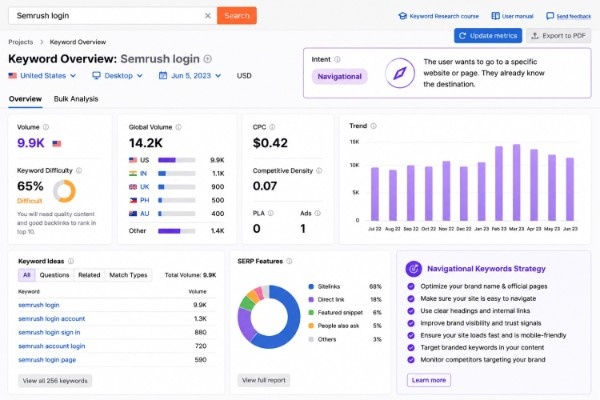
These searches show strong brand awareness because the user already has a destination in mind.
Common Navigational Keyword Formats
- Searches containing a brand or company name
- Login or account-related searches
- Brand-specific tools or services
- Searches for official blogs, pricing pages, or dashboards
Examples of navigational keywords:
- Semrush login
- Neil Patel blog
- Ahrefs keyword explorer
- Google Search Console
Content That Works Best
- Optimized homepage
- Brand landing pages
- Pricing and login pages
- Product and tool pages
SEO Strategy for Navigational Keywords
If people are searching for your brand name, ensure your homepage and important pages are properly optimized and indexed in Google.
Competitor-related searches can sometimes be addressed with genuinely useful comparison content when the comparison is relevant to your audience. However, a comparison page should provide original information rather than simply trying to capture another brand’s navigational traffic.
3. Commercial Keywords
Commercial and transactional intent are closely related, but they are not the same. A commercial search usually indicates that the user is evaluating options, while a transactional search indicates a stronger intention to complete an action.
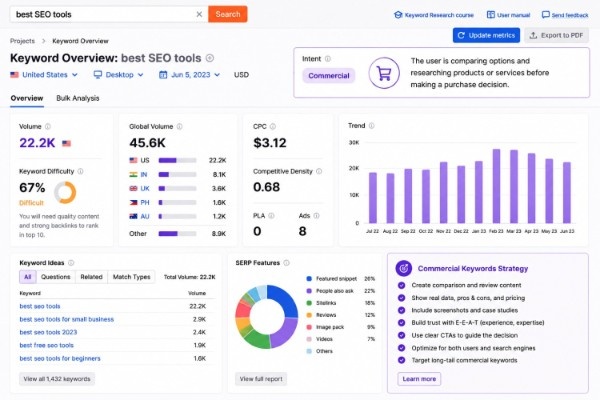
Users searching with commercial intent are actively researching products or services. They often compare features, pricing, reviews, and alternatives before purchasing.
Common Commercial Keyword Formats
- Best product or tool searches
- Comparison-based searches
- Product reviews and ratings
- Searches for alternatives or competitors
- Top tools or recommendation queries
Examples:
- Best SEO tools 2026
- Semrush vs Ahrefs
- Top keyword research tools
- Ubersuggest review
- Ahrefs alternatives
Content That Works Best
- Comparison articles
- Detailed review posts
- Listicles (Top 10 SEO Tools)
- Buying guides
- Case studies and real-world examples
SEO Strategy for Commercial Keywords
Commercial keywords often convert well because users are already close to making a decision. Focus on creating honest and detailed comparison content that includes features, pros and cons, pricing, and real use cases.
Adding personal experience and practical insights can also improve trust and credibility, especially after Google’s E-E-A-T updates, which reward experience-based content.
4. Transactional Keywords
Transactional keywords are used when a user is ready to take immediate action such as buying a product, signing up for a service, downloading a tool, or starting a free trial.
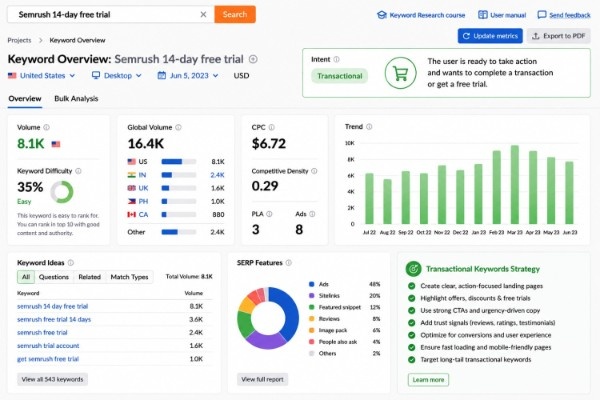
These are high-intent search queries that indicate strong purchase readiness, making them some of the most valuable keywords for businesses and conversions.
Common Transactional Keyword Formats
- Buy product searches
- Discount, coupon, or deal-related searches
- Free trial and signup searches
- Download-focused queries
- Price-sensitive searches like cheap or affordable.
Examples:
- Buy Semrush subscription
- Ahrefs free trial
- Sign up for Google Search Console
- Download keyword planner
- Affordable SEO tools
Content That Works Best
- Product and service landing pages
- Pricing pages
- Free trial signup pages
- Sales pages
- Checkout and conversion-focused pages
For a broader checklist of page-level SEO improvements, see our guide to on-page SEO best practices.
SEO Strategy for Transactional Keywords
Transactional keywords are designed to drive conversions, so your pages should focus on trust, speed, and user experience. Use strong calls-to-action (CTAs), customer reviews, testimonials, guarantees, and clear pricing information. Fast-loading pages and mobile-friendly design also improve conversions. Adding structured data like Product, Offer, and Review schema can help improve visibility in Google search results and increase click-through rates.
Keywords are also commonly described by their length and specificity. Terms such as short-tail, mid-tail, and long-tail are useful SEO conventions, but there is no universal Google rule that defines exactly how many words each category must contain.
Types of Keywords Based on Length
Beyond intent, keywords are also classified by their length and each category has very different SEO implications.
Short-Tail Keywords (Head Keywords)
- Example: keywords, SEO, content.
- Competition: Extremely high
- Conversion rate: Low
Short-tail keywords are broad and often more competitive because they can represent a wide range of search needs. Whether they are worth targeting depends on your website, audience, topic, and competition.
Mid-Tail Keywords
- Example: types of keywords, keyword research tips
- Competition: Medium
- Conversion rate: Medium
Mid-tail keywords strike a balance between search volume and competition. They’re often the sweet spot for growing blogs and websites.
Long-Tail Keywords
- Example: how to find transactional keywords for ecommerce.
- Competition: Low
- Conversion rate: High
Long-tail queries are often more specific than broader terms, which can make them useful when your goal is to match a clearly defined search need. Their competition and conversion potential can vary by topic and audience.
Types of Keywords Based on Competition
High-Competition Keywords
- Dominated by big brands
- Require strong domain authority + extensive backlinks
- Examples: SEO, keyword research, digital marketing.
Medium-Competition Keywords
- Competition depends on the search results, competing pages, topic, and the authority and relevance of the websites ranking for the query.
- Require good content + some backlinks
- Examples: types of keywords in SEO, keyword intent guide.
Low-Competition Keywords
- Perfect for new websites
- Can rank with great content alone
- Examples: how to find transactional keywords for Shopify store India
Tool to Check Competition: Use Keyword Difficulty (KD) scores in tools like:
- Semrush Keyword Magic Tool
- Ahrefs Keywords Explorer
- Ubersuggest
- Google Keyword Planner
Types of Keywords Based on Funnel Stage
One of the most powerful ways to think about keywords is through the lens of your content/marketing funnel:
TOFU (Top of Funnel)     → Informational Keywords
     ↓
MOFU (Middle of Funnel)  → Commercial Keywords
     ↓
BOFU (Bottom of Funnel)  → Transactional Keywords
TOFU Keywords (Awareness Stage)
The user doesn’t know your brand yet. They have a problem or question.
- what are SEO keywords
- how does Google Search work
- why is content marketing important
Goal: Attract new visitors, build brand awareness, start the relationship.
MOFU Keywords (Consideration Stage)
The user knows they need a solution. They’re evaluating options.
- best keyword research tools
- Semrush vs Ahrefs comparison
- keyword research tools for beginners
Goal: Position your product/service as the best solution.
BOFU Keywords (Decision Stage)
The user is ready to act. They just need a final push.
- Semrush 14-day free trial
- Ahrefs coupon code 2026
- best affordable keyword tool for small business
Goal: Convert the visitor into a customer.
Why Funnel-Based Keywords Matter in SEO
Using TOFU, MOFU, and BOFU keywords helps create a complete SEO strategy. Instead of targeting only high-volume keywords, you guide users through every stage of the customer journey.
This strategy helps:
- increase organic traffic
- improve conversions
- build topical authority
- strengthen internal linking
- support long-term SEO growth
A funnel-based keyword strategy can help businesses plan content for different stages of the customer journey, from learning and comparison to taking action.
How Google Understands Keyword Intent in 2026 (AI Search)
In 2026, Google’s search has fundamentally changed with the widespread rollout of AI Overviews (formerly Search Generative Experience). Here’s what that means for keyword strategy:
Read More – https://klientsolutech.com/best-free-ai-tools-for-non-tech-users-2026/
How Keyword Intent Relates to AI Search
Google Search can use AI features such as AI Overviews and AI Mode to help users explore complex questions. However, there is no separate AI SEO formula that requires keyword stuffing, artificial content structures, or creating a separate page for every query variation.
These principles are also covered in Google’s guidance on creating helpful, reliable, people-first content.
For a keyword-focused article, this means answering the main question directly and then providing the supporting explanations, examples, comparisons, and practical information a reader would reasonably need.
For Google’s official guidance on AI features in Search, see Google Search Central’s AI features documentation.
How to Optimize for AI Overviews
- Write a clear, concise definition in the first 100 words
- Use structured headers (H2/H3) to organize your content
- Add bullet points, tables, and short paragraphs for easy reading
- Answer the exact question directly avoid fluff
- Include author bio and real experience to strengthen E-E-A-T signals
- Use FAQ sections to match question-based long-tail queries
| Keyword Type | User’s Goal | Example | Suitable Content |
|---|---|---|---|
| Informational | Learn | what is SEO | Guide |
| Navigational | Find a specific page/site | Google Search Console login | Official/login page |
| Commercial | Compare options | best SEO tools | Comparison |
| Transactional | Take action | buy SEO software | Product/service page |
How to Find the Right Keyword Type for Your Content
Step 1: Identify the Search Intent
Search the keyword in Google and review the types of pages that appear. Look for patterns across the results rather than relying on only one or two pages
- If they’re guides/blog posts → informational intent
- If they’re comparison pages → commercial intent
- If they’re product/pricing pages → transactional intent
- If they’re brand homepages → navigational intent
Match your content format to what’s already ranking.
Step 2: Check SERP Features
Look for what Google shows in the SERP:
- Featured snippet → Optimize your definition paragraph
- People Also Ask → Add FAQ section with those exact questions
- AI Overview → Write structured, citable content
- Shopping results → Transactional intent confirmed
- Local pack → Local intent; optimize for GMB
Step 3: Use Keyword Research Tools
| Tool | Best For |
|---|---|
| Semrush Keyword Magic Tool | Large-scale keyword research + intent filter |
| Ahrefs Keywords Explorer | Keyword difficulty + traffic potential |
| Google Keyword Planner | Volume data (free) |
| Ubersuggest | Beginner-friendly + affordable |
| Google Search Console | Finding keywords you already rank for |
Step 4: Analyze Competitor Content Gaps
Competitor research can reveal related topics and questions that your article may not cover. Use these findings as research input, then create your own useful explanation rather than rewriting competitor content.
In Semrush:
Competitive Research → Keyword Gap → Enter your domain + competitors → Filter by Missing keywords
In Ahrefs:
Site Explorer → Content Gap → Enter competitor domains
Once you’ve identified the right keywords, you can apply them as part of a broader SEO strategy for growing organic visibility.
Common Keyword Mistakes to Avoid
Mistake 1: Targeting Only High-Volume Keywords
High volume = high competition. New sites should focus on long-tail keywords first.
Mistake 2: Ignoring Search Intent
If the pages ranking for a query are mostly product, service, or comparison pages, publishing a purely informational article may not satisfy the searcher’s goal. Check the search results and choose a content format that genuinely meets the intent.
Mistake 3: Keyword Stuffing
Avoid forcing the same keyword into headings, paragraphs, or lists simply to increase keyword frequency. Use natural language and relevant terminology when they genuinely help explain the topic.
Google’s Search Essentials also identifies spam policies and practices that site owners should avoid.
Mistake 4: Not Updating Old Content
Review important articles when their information becomes outdated, the search landscape changes, or Search Console shows new queries that the page could answer more effectively.
Mistake 5: Ignoring Long-Tail Keywords
Specific queries can reveal a clearly defined user need. Instead of chasing only broad terms, look for relevant questions and detailed searches that your audience actually uses.
Mistake 6: Targeting One Keyword Per Page
Modern SEO means one page can and should rank for dozens of related keywords. Use semantic SEO to cover a topic deeply.
Choosing keywords without considering competition is one common SEO mistake. For more examples, see our guide to common SEO mistakes and how to fix them.
Real-World Keyword Examples (Indian + Global)
Indian Ecommerce Example
| Keyword | Type | Intent | Best Content |
|---|---|---|---|
| what is digital marketing | Informational | Learn | Guide/Blog |
| best digital marketing courses India | Commercial | Compare | Comparison list |
| enroll in digital marketing course | Transactional | Buy | Landing page |
| DigitalVidya login | Navigational | Navigate | Homepage |
If you’re applying keyword research to an online store, see our guide on SEO for online store websites.
Global SaaS Example
| Keyword | Type | Intent | Best Content |
|---|---|---|---|
| what is CRM software | Informational | Learn | Explainer guide |
| HubSpot vs Salesforce | Commercial | Compare | Comparison post |
| HubSpot free trial signup | Transactional | Act | Pricing page |
| HubSpot login | Navigational | Navigate | Homepage |
Blogger/Content Creator Example
| Keyword | Keyword Type | Why |
|---|---|---|
| keyword research | Short-tail | Broad topic |
| types of keywords | Mid-tail | More specific topic |
| how to find low competition keywords for a new blog | Long-tail | Highly specific query |
FAQs
1 What are the 4 main types of keywords in SEO?
The four main types of keywords based on search intent are: informational (users want to learn), navigational (users want to find a specific site), commercial (users are comparing options), and transactional (users are ready to take action). Each type requires a different content format and SEO strategy.
2 Why are long-tail keywords important in SEO?
Long-tail keywords are specific search queries that often describe a clearer user need. They can be useful for reaching a focused audience, especially when a broader keyword is too general or competitive. However, their search volume and competition vary by topic, location, and industry.
3 Which type of keyword is best for a new website?
There is no single keyword type that is best for every new website. Specific, relevant keywords can be a practical starting point because they often have a clearer search intent. Choose keywords based on relevance, competition, the needs of your audience, and whether your website can provide a genuinely useful answer.
4 How does Google understand keyword intent?
Short-tail keywords are broad and generally less specific, while long-tail keywords are more specific and often describe a particular search need. There is no universal Google rule defining them by an exact number of words. For example, SEO is broad, while “how to do keyword research for a new blog” is much more specific.
5 What is the difference between commercial and transactional keywords?
Commercial keywords are used when users compare products or services before buying, while transactional keywords indicate the user is ready to take action immediately, such as purchasing or signing up.
6 What is keyword search intent?
Keyword search intent (also called user intent) is the underlying reason or goal behind a search query. Google uses search intent to determine which type of content should rank for a keyword. The four intent categories are: informational, navigational, commercial, and transactional.
7 What is the difference between short-tail and long-tail keywords?
Short-tail keywords are broad and generally less specific, while long-tail keywords are more specific and often describe a particular search need. There is no universal Google rule defining them by an exact number of words. For example, SEO is broad, while how to do keyword research for a new blog is much more specific.
8 How many types of keywords are there in SEO?
SEO keywords can be classified in multiple ways: by intent (4 types: informational, navigational, commercial, transactional), by length (3 types: short-tail, mid-tail, long-tail), by competition (high, medium, low), and by funnel stage (TOFU, MOFU, BOFU). A complete keyword strategy considers all of these dimensions together.
9 How do I identify the type of a keyword?
Look at what the searcher wants to accomplish. If they want to learn something, the keyword is usually informational. If they want to find a specific website or page, it is navigational. If they are comparing products, services, or options, it is commercial. If they are ready to buy, sign up, download, or take another action, it is transactional. When the intent is unclear, check the types of pages currently appearing in Google Search and identify the dominant intent.
10 Can a keyword have more than one search intent?
Yes. Search intent is not always completely clear-cut, and a keyword can have overlapping intent depending on the context. For example, someone searching for best SEO tools may be comparing options (commercial) but may also be close to making a purchase (transactional). When intent overlaps, look at the search results and create content that best satisfies the user’s primary need.