Most e-commerce businesses run paid advertising. But these days, they are spending more per customer than they were three years ago, and getting less in return.
Google Ads cost-per-click across e-commerce categories has risen more than 50% globally since 2021. Meta’s return on ad spend never fully recovered after iOS privacy changes reshaped attribution. And the stores that built their acquisition model entirely on paid channels are now operating on margins that leave very little room for error.
Let’s go through some facts below:
- Zero Marginal Cost: While a Google Shopping ad might cost $1.15 per click, a well-ranked category page for a high-intent query (like “sustainable leather boots”) generates traffic at zero cost-per-click.
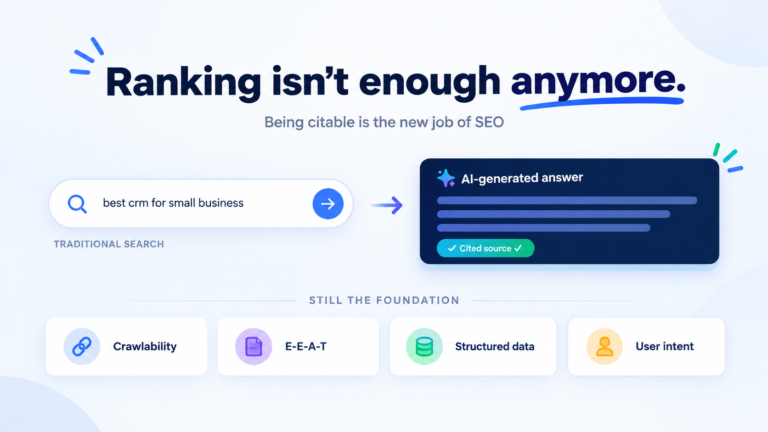
- The AI Resilience: Despite the rise of AI-powered search, transactional queries still drive the bulk of e-commerce revenue. Strategic SEO ensures your product pages appear where customers are making active buying decisions, not just seeking information.
- Technical High-Impact Wins: For many stores, the highest ROI comes from fixing technical debt. For example, optimising “faceted navigation”, the filters for size, colour, and price can reclaim a massive portion of a site’s crawl budget, allowing Google to index the pages that actually convert.
This is not a temporary market condition. It is a structural shift in how online retail works. Understanding how central e-commerce has become to modern commerce is the starting point for understanding why the channel you use to acquire customers matters as much as the products you sell.
The businesses growing consistently in 2026 made a deliberate investment in search engine optimisation – not as a supplementary channel, but as a primary growth asset.
This article explains why that investment compounds in ways that paid advertising structurally cannot, and what it actually takes to build organic visibility that drives ecommerce revenue at scale.
Related: Importance of e-commerce in our daily life
In practical terms, most modern online stores are built on platforms like Shopify, WooCommerce, Magento, or custom frameworks. While these platforms make it easy to launch a store, they do not automatically ensure search visibility.
SEO must be deliberately implemented across product pages, category structures, and technical configurations for sustainable growth.
For example, targeting keywords like ‘buy [product] online’, ‘best [product] in India’, and ‘[product] price in India’ across your category and product pages helps improve visibility for high-intent searches.
The Problem With Paid Acquisition
For example, a Shopify or WooCommerce store investing heavily in paid ads may see immediate traffic, but the moment campaigns stop, visibility disappears. This highlights why relying only on paid acquisition is risky for long-term ecommerce growth.
Every dollar spent on Google Ads or Meta buys visibility for exactly as long as the campaign runs. The moment the budget stops, the traffic stops. Nothing permanent is built. No authority accumulates. No asset remains after the spend.
A mid-sized Australian furniture retailer spending $15,000 per month on Google Shopping campaigns will generate traffic at a cost-per-click of $4 to $12, depending on the category. Remove the budget for a month, and organic sessions from paid channels drop to zero. The $15,000 spent in month one has produced no residual value.
Now let’s compare that with the SEO impact of a category page that has earned a top-three organic ranking for “outdoor dining settings Australia.” That page generates traffic every day at zero marginal cost per click. The work done to rank it in month four is still producing results in month twenty-eight. The investment compounds rather than resets.
This asymmetry is why ecommerce businesses that commit to organic search consistently report higher return on investment over a 12- to 18-month horizon than those relying on paid acquisition alone. The maths is straightforward – a channel with zero ongoing cost-per-click and compounding visibility has fundamentally different economics than one where every visitor requires a payment.
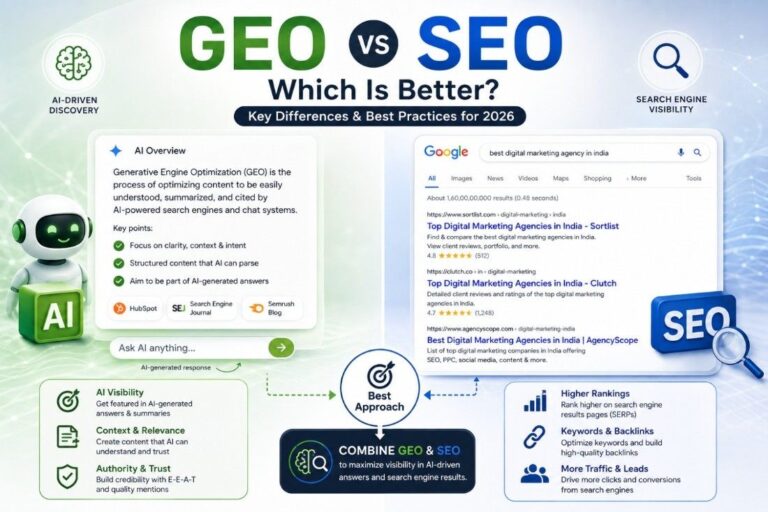
AI impact on organic search results and SEO
There is a widespread assumption that AI is reducing the value of organic search for e-commerce. The actual picture is more precise than that and largely works in favour of businesses with genuine product expertise.
Google’s AI Overviews appear most frequently on informational queries. A search like “how to choose a sofa for a small apartment” may produce an AI Overview that summarises general guidance.
A search like “buy 3-seater sofa Melbourne” or “king bed frame free delivery Sydney” almost never triggers an AI Overview – these transactional and commercial investigation queries continue to surface traditional organic results, driven by the same authority and relevance signals they always have.
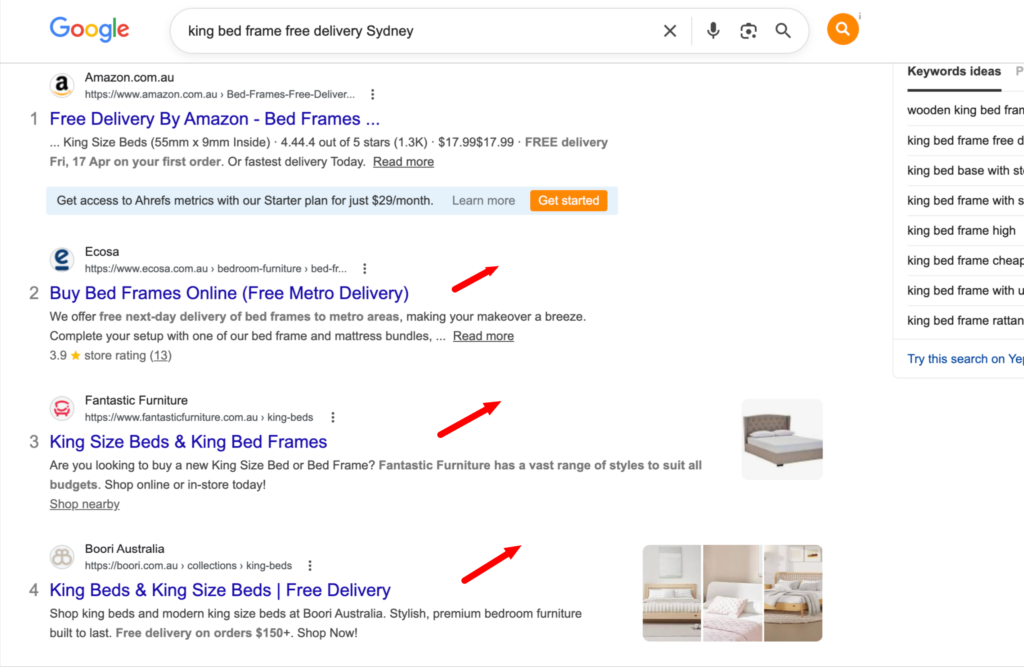
The e-commerce queries that generate revenue are overwhelmingly transactional and commercial. These are precisely where AI has changed the least. What AI has changed is the quality bar for content across all query types. Google’s AI systems now detect thin, recycled, and low-expertise content far more reliably than earlier algorithm iterations. Category pages built around keyword density rather than genuine buyer intent are losing ground. Pages with original data, clear product expertise, and content that genuinely serves the research phase of the buying journey are gaining ground.
This is where internal linking becomes powerful—linking informational blogs to product and category pages helps convert research traffic into buyers.
A real example illustrates this. A home goods retailer investing in category-level content that explains material differences between solid timber and engineered wood furniture – drawing on actual product specifications and customer return data – will outperform a competitor whose category pages contain generic descriptions. The information is harder to produce but the ranking outcomes reflect the quality gap.
For e-commerce businesses with real product knowledge, AI’s effect on search has been a competitive advantage. Generic content farms that were occupying organic results are losing visibility. Stores with genuine category expertise are gaining it.
Global Competition and the Local Authority Advantage
Global ecommerce platforms have expanded their organic search presence significantly across English-speaking markets. Amazon, Wayfair, and newer entrants like Temu and Shein have built substantial organic visibility through content volume and aggressive link acquisition. For regional ecommerce operators, this might appear to be an insurmountable structural disadvantage.
It is not. And understanding why requires looking at what global platforms are structurally unable to do.
A global marketplace cannot build genuine local authority signals. Australian domain extensions, backlinks from Australian industry publications and business associations, content that addresses Australian-specific buying considerations – these signals accumulate naturally for locally-operated businesses and cannot be replicated at scale by global platforms without significant, sustained local investment that most of them have not made.
Consider a speciality lighting retailer operating across New South Wales and Victoria. Its website earns backlinks from Australian interior design publications, is featured in local home renovation forums, and publishes content addressing Australian electrical standards and local supplier availability. These authority signals compound over time and create an organic position in Australian search results that Wayfair’s global SEO budget cannot simply purchase.
The same principle applies to furniture store SEO in Australia, where buyers frequently search for suburb-specific delivery availability, Australian warranty terms, and locally-stocked products. A local retailer that builds content around these queries owns them by default – because a global platform is not going to create content about delivering to Ballarat or Penrith specifically.
Regional authority is a genuine moat in e-commerce SEO. The businesses that build it deliberately in 2026 create a defensible position that paid advertising from global competitors cannot easily displace.
The Technical Foundation that Most E-Commerce Stores Are Getting Wrong
Each ecommerce platform comes with its own SEO strengths and limitations. Shopify simplifies store management but requires careful handling of duplicate URLs and limited structural control. WooCommerce offers flexibility but depends on proper plugin management, hosting performance, and speed optimisation. Larger platforms like Magento or custom-built stores require strong technical SEO implementation from the start.
Regardless of platform, core SEO elements remain the same: optimised product descriptions, clear category hierarchy, mobile responsiveness, fast loading speed, and structured data implementation.
A significant portion of ecommerce businesses operating today have at least one major technical SEO issue actively suppressing their organic performance. In most cases, fixing it produces faster visibility gains than any content or link acquisition work – because the content was already there, just inaccessible to Google’s crawlers.
The most common and most costly technical issue is unmanaged faceted navigation. E-commerce filter systems – allowing customers to sort by colour, size, price, material, and category – generate large numbers of URL combinations. Without proper canonical tag management and crawl directive configuration, Google’s crawlers spend their allocated crawl budget on these filter URL variants instead of on the category and product pages that actually rank and drive revenue.
A practical example illustrates the scale of the problem. An Australian homewares retailer with 8,000 products and faceted filtering across six attributes can generate more than 500,000 indexable URL combinations. If these are not managed correctly, Google is distributing crawl budget across half a million low-value pages instead of efficiently indexing the store’s core category and product pages. The result is slow or incomplete indexation – and rankings that significantly underperform the store’s actual authority and content quality.
The fix requires e-commerce-specific technical expertise. It involves configuring canonical tags to direct authority to primary category pages, using noindex directives on filter combinations that serve user experience but should not rank independently, and optimising crawl budget allocation through robots.txt and XML sitemap configuration. None of this is conceptually complex, but implementation errors are common, and the consequences of getting it wrong are substantial.
Beyond faceted navigation, structured data implementation is the second most consistently missed technical opportunity. Product schema, breadcrumb schema, and review schema determine whether Google surfaces rich snippets – star ratings, price information, and availability status – directly in search results. Stores without correctly implemented structured data are invisible to these enhanced result formats, while competitors with equivalent content and authority capture meaningfully higher click-through rates simply by having schema in place.
The Compounding Timeline Most Businesses Underestimate
The most common reason ecommerce businesses abandon SEO investment prematurely is a mismatch between expected and actual timelines. Most of the businesses that tried SEO and concluded it did not work pulled back at month three, which is precisely when the foundational work is complete, but before compounding returns have had time to develop.
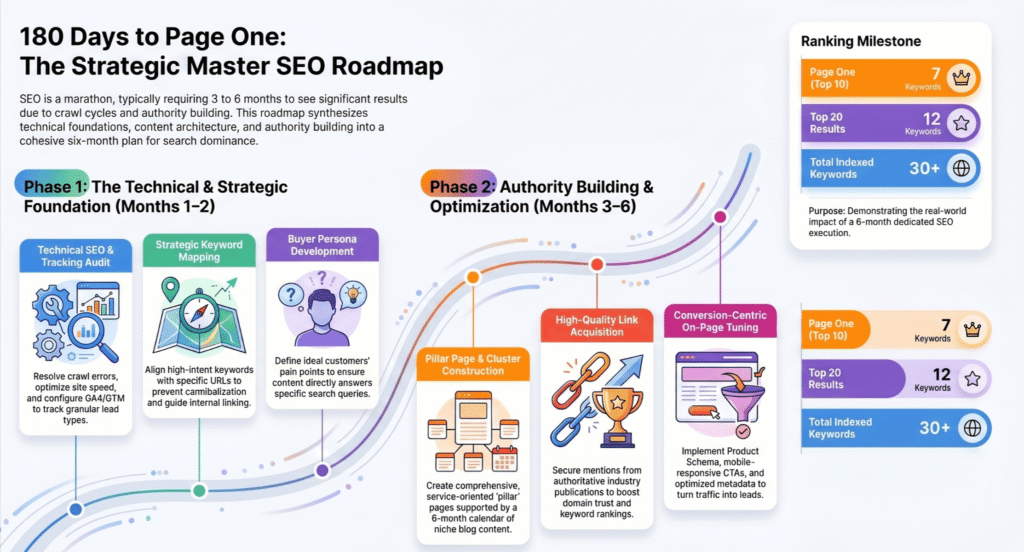
A realistic progression for an e-commerce store with a reasonably healthy site and moderate domain authority looks like this.
In months one and two, the work is almost entirely foundational – technical audit, crawl issue resolution, keyword mapping to category and product pages, on-page element optimisation, and tracking configuration. Visible ranking movement in this period is limited, and that is expected. This phase is building the conditions that allow subsequent work to produce results.
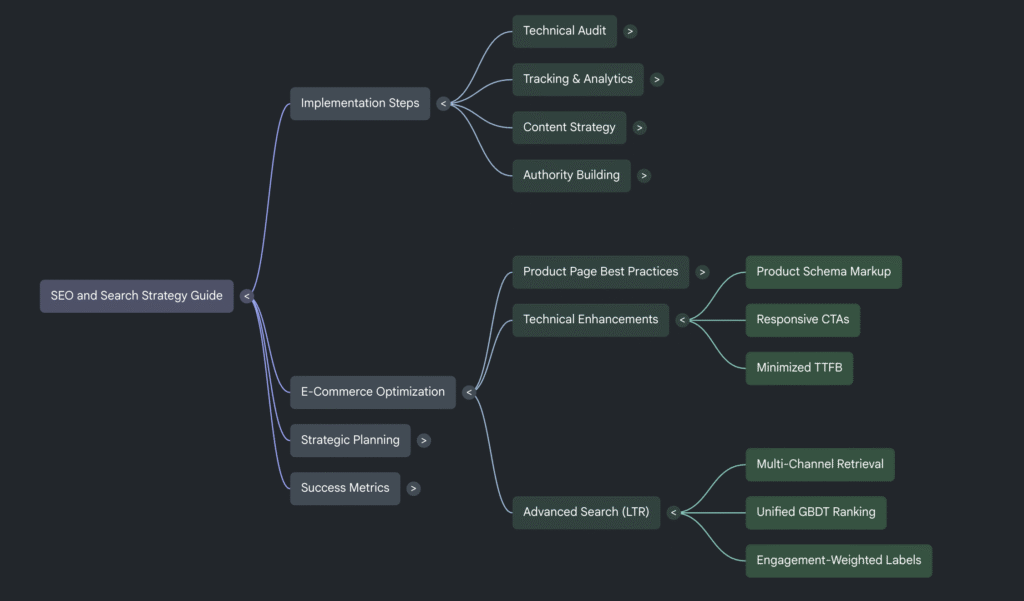
In months three and four, early signals appear. Pages sitting on pages two and three begin moving toward page one. Search Console impression volumes grow noticeably before click volumes do – this is the correct early indicator that ranking progress is accumulating. Clicks follow impressions with a lag as positions improve.
In months five and six, organic begins contributing visibly to revenue. Commercial intent category and product pages are now generating sessions from buyers rather than just researchers, and conversion data starts to reflect the quality of that traffic.
From month nine onward, the compounding dynamic becomes clear. Pages that ranked on page one accumulate the user engagement signals – click-through rate, dwell time, and low bounce rate – that reinforce their positions. Content published in month three is now mature enough to earn organic links from external sites. Domain authority is building across the board. New pages added to the site rank faster than early pages did because the domain’s overall authority has strengthened.
A business that understands and commits to this trajectory builds a growth asset. A business that evaluates SEO at month three and concludes it is not working resets all progress and faces the same early-stage patience requirement whenever it tries again.
Why Vertical Expertise Produces Better Results Than General Strategy
Understanding what a complete e-commerce SEO strategy involves makes it clear why the specific expertise of the practitioner matters as much as the budget allocated to the work.
An SEO strategy designed for a B2B lead generation website applies poorly to an e-commerce store. The keyword structure is different – ecommerce targets transactional and commercial investigation queries at scale across a large product catalogue, not a small set of high-value service terms.
The content requirements are different – e-commerce needs category-level expertise and product-specific content, not long-form thought leadership. The technical architecture is different – e-commerce sites have faceted navigation, product variant management, and inventory-driven content challenges that non-ecommerce sites do not face.
Even within e-commerce, vertical matters. A supplement brand competing on health and wellness queries operates in a completely different search landscape from a furniture retailer competing on home and living queries. The link acquisition targets are different. The content supporting the buyer research phase is different. The seasonal demand patterns and the category architecture best practices are different.
A generic SEO playbook applied to a specific e-commerce vertical produces generic results. A strategy built around the actual buyer behaviour, search patterns, and technical requirements of a specific category produces category-specific results that compound over time.
This is why the EcomOptix ecommerce SEO guide for Australia focuses specifically on Australian market conditions rather than recycling advice from US-centric content. Average order values, competitive landscapes, and seasonal buying patterns in Australia differ from those in the US and UK markets. A strategy that ignores this produces results that are always slightly off-target.
Measuring Results Correctly
If the primary metric being reported on is keyword ranking position, the business is being measured against the wrong thing.
Rankings matter as a directional indicator of whether organic visibility is building. A site improving from position 14 to position 6 on a high-intent commercial keyword is making progress worth tracking. But a site ranking in position one for an informational query with no purchase intent behind it is generating traffic that contributes almost nothing to revenue.
The metrics that actually matter for e-commerce SEO are organic revenue reported in GA4, organic sessions from commercial intent queries specifically, and assisted conversion contribution from organic sessions that were part of a customer’s multi-touch path before purchasing through another channel. These connect SEO performance directly to business outcomes.
Tracking keyword groups such as transactional (buy, price, discount), informational (how, best, guide), and comparison (vs, review) helps better understand which content drives revenue.
Separating informational traffic from commercial traffic in organic reporting requires deliberate configuration – tagging queries by intent category in GA4 custom reports rather than reviewing aggregate organic session data. Businesses that make this distinction in their reporting quickly develop a much clearer picture of which content and which category pages are actually driving revenue, and where investment is most likely to produce commercial returns.
Understanding how professional SEO operations are structured to produce these kinds of revenue-connected outcomes helps businesses set the right expectations and ask the right questions of whoever is managing their organic growth.
The Strategic Position in 2026
E-commerce in 2026 is more competitive than it has been at any previous point. PPC costs are high and rising. AI has raised the quality threshold for content that earns organic visibility. Global platforms are extending their reach into regional markets. Consumer expectations for online shopping continue to increase.
In this environment, the businesses with the strongest strategic position are those that own their organic categories rather than renting paid visibility in them. Organic authority builds over time and does not evaporate when market conditions change or advertising platforms update their policies. A store with a genuine organic presence in its category is significantly more resilient to market shifts than one dependent on paid acquisition.
The businesses that will own their categories organically in 2028 are the ones making consistent, structured SEO investment now. Not because results are immediate – they are not. But because every month of accumulated organic authority creates a larger gap between those businesses and competitors who are still paying for every single visit.
The case for e-commerce SEO in 2026 is not that it is fast or simple. It is that it is the only growth channel that builds an asset that appreciates rather than a cost that compounds.
EcomOptix works specifically with ecommerce stores that have reached the scale where making that investment produces meaningful, measurable returns.
Is ecommerce SEO worth the investment, given rising competition from global platforms?
Yes – and the argument is stronger in competitive markets than in less competitive ones. Global platforms have structural weaknesses in local authority signals that regional businesses can systematically exploit. Locally-earned backlinks, market-specific content, and regional buying-intent queries create an organic position that global competitors cannot purchase with budget alone.
How has AI affected ecommerce organic search results in 2026?
AI Overviews appear most on informational queries and rarely on the transactional and commercial investigation queries that drive ecommerce revenue. In those high-value commercial results, traditional organic ranking signals continue to determine visibility. The more significant AI effect has been on content quality standards – AI filters have reduced the visibility of thin, generic content and rewarded content with genuine product expertise and original information.
What is the realistic timeline for ecommerce SEO to produce revenue?
For stores with reasonably sound technical foundations, meaningful revenue contribution from organic typically emerges between months four and six. Compounding returns – where organic becomes a primary revenue channel – generally develop between months nine and eighteen depending on competition level, starting domain authority, and how consistently the investment is maintained.
What is faceted navigation and why does it matter for ecommerce SEO?
Faceted navigation refers to filter systems on ecommerce sites that allow customers to sort products by attributes like colour, size, price, and material. Without proper technical management, these systems generate very large numbers of indexable URL combinations that consume Google’s crawl budget without producing rankable pages. Fixing faceted navigation is often the highest-impact technical SEO intervention available to an ecommerce store.
How should ecommerce SEO performance be measured?
Organic revenue in GA4, organic sessions from commercial intent queries specifically, and assisted conversion contribution from organic sessions are the primary metrics that connect SEO work to business outcomes. Ranking position and total organic session volume are useful directional indicators but insufficient as primary success metrics on their own.
Why does vertical-specific SEO expertise produce better results than a general approach?
Ecommerce has technical and strategic requirements that differ substantially from other website types – large catalogue management, faceted navigation, product variant handling, transactional content at scale, and category-specific buyer research behaviour. These requirements vary further by product vertical. A practitioner with specific experience in a given ecommerce category will produce better outcomes than one applying a general SEO framework because the strategy is calibrated to how buyers in that category actually search and purchase.