On-Page SEO is one of the foundational topics tested in almost every SEO interview. Whether you’re a fresher applying for your first SEO role or an experienced professional targeting a senior position, interviewers consistently check how well you understand content optimization, technical elements, site structure, and user experience factors that influence search visibility.
This blog covers the Top 50 On-Page SEO interview questions and answers, ranging from basic definitions to advanced technical concepts. Every answer comes with a short, practical example so you understand not just the theory but how it applies in real SEO work. The explanations reflect current, accurate SEO practices rather than oversimplified or outdated rules.
On-Page SEO Interview Questions Table of Contents
- Basic On-Page SEO Questions
- Content & Meta Optimization Questions
- Technical On-Page Questions
- UX & Media Questions
- Advanced On-Page SEO Questions
1. Basic On-Page SEO Questions
1. What is On-Page SEO?
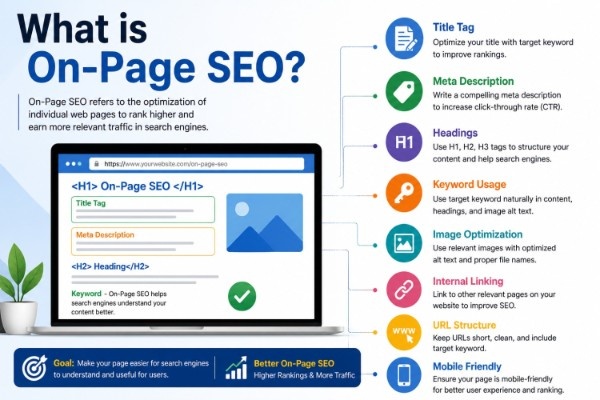
Answer: On-Page SEO refers to optimizing elements within your own website such as content, HTML structure, and internal links to improve search visibility and relevance for target queries. It gives search engines and users clearer context about what a page is about.
Example: Optimizing a blog post’s heading structure and content to better match a target search query.
2. How is On-Page SEO different from Off-Page SEO?
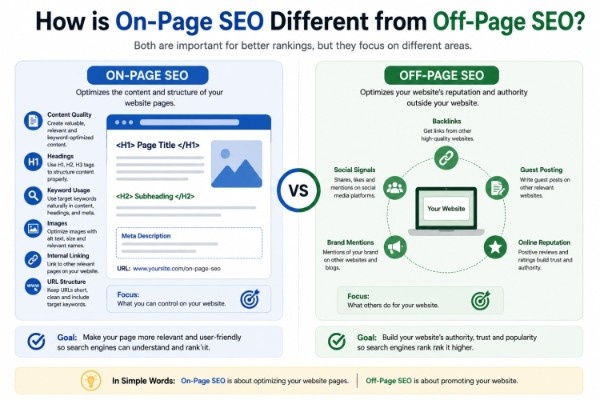
Answer: On-Page SEO involves optimizing elements directly on your website, while Off-Page SEO involves external activities like backlinks and brand mentions that build authority from outside sources.
Example: Improving a page’s title tag is On-Page; earning a link from another website is Off-Page.
3. Why is On-Page SEO important?
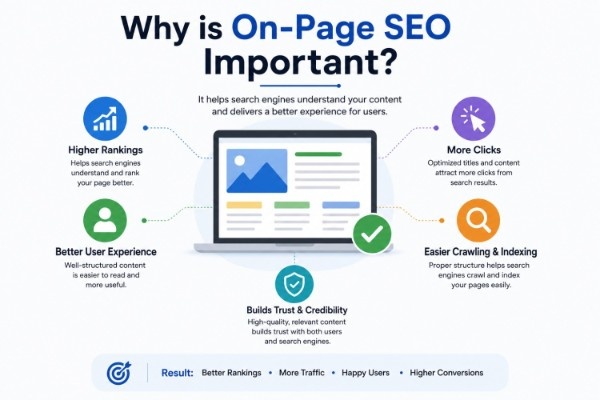
Answer: It helps search engines understand a page’s topic and relevance, and helps users find what they’re looking for more easily. Well-optimized on-page elements can support better rankings, though they work alongside other factors like backlinks and technical health.
Example: A clearly structured, well-optimized product page can rank and convert better than a cluttered, unclear one.
For websites looking to improve organic visibility further, combining on-page optimization with proven SEO strategies to grow website traffic can create a stronger overall SEO foundation.
4. What is a title tag?

Answer: A title tag is an HTML element that defines the title of a web page, shown in search results and browser tabs. It’s one of the clearer on-page relevance signals for a page’s topic.
Example: A page titled Best Running Shoes for Beginners Brand Name clearly signals its topic.
5. What is a meta description?
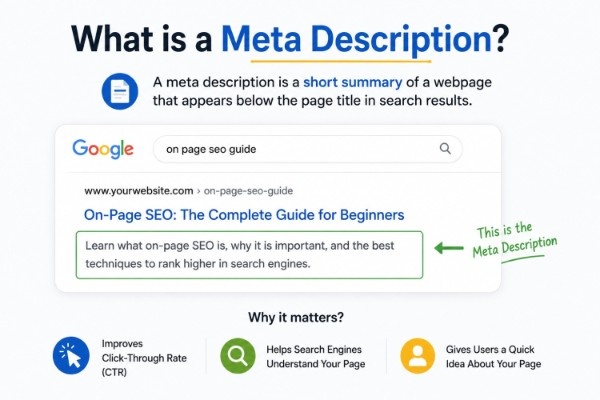
Answer: A meta description is a short HTML summary of a page’s content, shown below the title in search results. It doesn’t directly influence rankings but can affect click-through rates.
Example: A concise, compelling meta description encouraging a searcher to click through to a product page.
6. What are header tags (H1, H2, H3)?
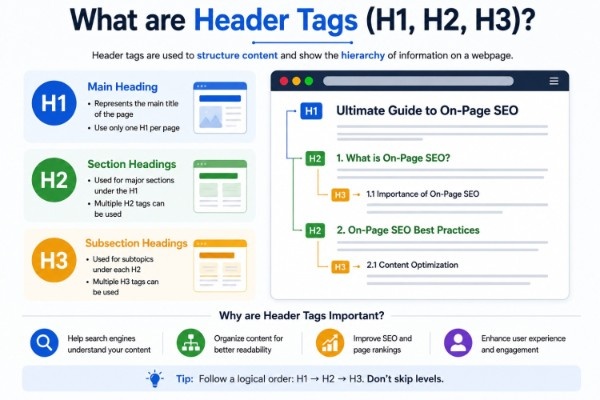
Answer: Header tags structure content hierarchically, with H1 typically representing the main heading and H2/H3 organizing subtopics. They help both readers and search engines navigate content more easily.
Example: Using an H1 for the article title and H2s for each major section like Benefits and How It Works.
7. What is keyword density?
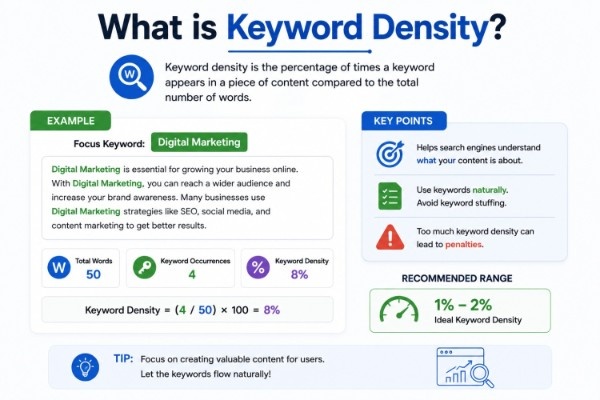
Answer: Keyword density refers to how often a target keyword appears relative to the total word count of a page. It’s a dated metric modern SEO focuses more on natural language and topical relevance than hitting a specific keyword percentage.
Example: Writing naturally about a topic instead of repeating a keyword an exact number of times.
8. What is keyword placement?
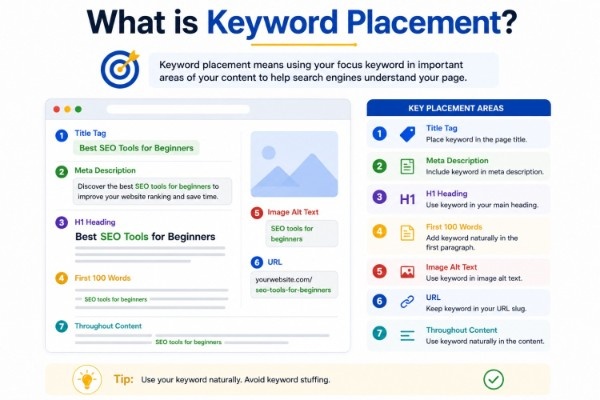
Answer: Keyword placement refers to positioning relevant keywords in strategic areas like the title, headings, URL, and early in the content, helping communicate topical relevance without over-optimizing. Understanding the different types of keywords in SEO can also help you choose the right primary and supporting keywords for each page.
Example: Naturally including a primary keyword within the first paragraph of a blog post.
9. What is content relevance?
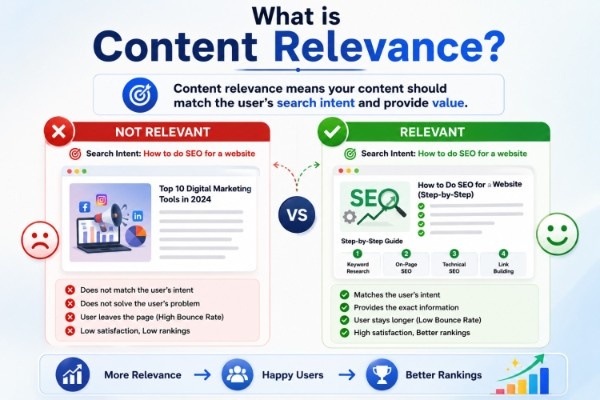
Answer: Content relevance describes how well a page’s content matches the intent and expectations behind a given search query. Search engines aim to match user intent, not just keyword matches.
Example: A page about “how to train a puppy” should include practical training steps, not just product promotions.
10. What is search intent?
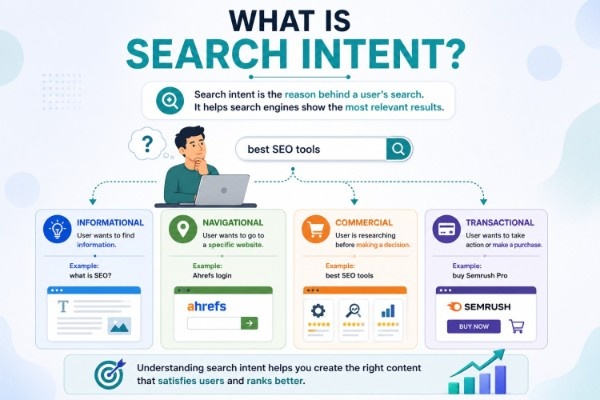
Answer: Search intent refers to the underlying goal behind a user’s search query informational, navigational, transactional, or commercial investigation. Content should align with the intent behind the query it targets.
Example: Someone searching best laptops 2026 likely wants a comparison list, not a single product page.
2. Content & Meta Optimization Questions
11. What makes content high quality from an SEO perspective?
Answer: High-quality content is accurate, well-organized, genuinely useful, and demonstrates relevant expertise or experience on the topic, aligning with search intent rather than being written purely to target keywords.
If you’re creating content for organic search, following a structured process for writing SEO-friendly blog posts can help improve both readability and search optimization.
Example: An in-depth guide written by someone with hands-on experience in the subject, rather than a generic rewritten summary.
12. What is content duplication and how does it affect SEO?
Answer: Duplicate content refers to identical or near-identical content appearing across multiple pages or websites. It can create confusion for search engines about which version to rank and may dilute visibility, though it isn’t automatically penalized.
Example: The same product description used on multiple category pages of an online store.
13. What is a canonical tag?
Answer: A canonical tag tells search engines which version of similar or duplicate pages should be treated as the primary one, helping consolidate ranking signals to a single URL.
Example: Using a canonical tag on a printer-friendly page version pointing to the main article URL.
14. What is thin content?
Answer: Thin content refers to pages with little unique value, substance, or depth often too short or generic to genuinely satisfy the search intent behind a query.
Example: A product page with just a title and price but no meaningful description.
15. What is content freshness and does updating content help SEO?
Answer: Content freshness refers to how recently a page has been meaningfully updated. For certain topics (like news or fast-changing information), updated and accurate content can be more useful to users, though freshness alone doesn’t guarantee better rankings.
Example: Updating a best tools article yearly to reflect new products and remove outdated ones.
16. What is internal linking?
Answer: Internal linking refers to links connecting pages within the same website, helping distribute authority, establish site structure, and guide both users and search engines to related content.
Example: A blog post about SEO interview preparation can link readers to a detailed On-Page SEO best practices guide to help them understand how these techniques are applied to real webpages.
17. What is a URL slug and how should it be optimized?
Answer: A URL slug is the readable part of a webpage’s address. An optimized slug is short, descriptive, and relevant to the page’s content, making it easier for users and search engines to understand.
Example: Using /on-page-seo-guide instead of /page?id=1234.
18. What is image alt text?
Answer: Alt text is a text description added to an image’s HTML primarily for accessibility. It also helps search engines understand the image’s content and its relationship to the surrounding page.
Example: Alt text like woman jogging on a trail at sunrise instead of leaving it blank or using image1.jpg.
19. What is content structure and why does it matter?
Answer: Content structure refers to how information is organized using headings, paragraphs, lists, and formatting, making content easier to scan and understand for both readers and search engines.
Example: Breaking a long guide into clear sections with headings instead of one long unbroken block of text.
20. What is topic clustering (content silos)?
Answer: Topic clustering involves organizing related content around a central pillar page, with supporting articles linking back to it, helping establish topical depth and clearer site structure.
Example: A Digital Marketing pillar page linking to supporting articles on SEO, PPC, and social media.
3. Technical On-Page Questions
21. What is a robots meta tag?
Answer: A robots meta tag gives instructions to search engine crawlers about whether a page should be indexed or whether its links should be followed.
Example: Adding a no index tag to a thank-you page that shouldn’t appear in search results.
22. What is schema markup (structured data)?
Answer: Schema markup is structured data added to a page that helps search engines understand its content and may make eligible content available for supported rich results.
Example: Adding recipe schema to a cooking blog so search results can display cook time and ratings.
Interview Tip: Be specific about which rich results are currently supported rather than assuming any schema type will automatically produce one.
23. What is mobile-friendliness and why is it important for On-Page SEO?
Answer: Mobile-friendliness refers to how well a page functions and displays on mobile devices. Google primarily uses the mobile version of a site’s content for indexing and ranking, making it important that mobile pages contain the same important content and structured data as desktop versions.
Example: A page with text that’s readable and buttons that are easily tappable on a smartphone screen.
24. What is page speed and how does it relate to On-Page SEO?
Answer: Page speed refers to how quickly a page loads and becomes usable. Slower pages can hurt user experience and are one of several factors that can influence rankings, particularly for competitive queries.
Example: Compressing large images to reduce a product page’s load time.
25. What are Core Web Vitals?
Answer: Core Web Vitals are a set of metrics measuring loading performance, interactivity, and visual stability of a page, used by Google as part of its broader page experience signals. The current metrics are Largest Contentful Paint (LCP), Interaction to Next Paint (INP), and Cumulative Layout Shift (CLS).
Example: Reducing layout shifts caused by ads loading after the main content has already rendered.
Interview Tip: Be ready to name all three metrics (LCP, INP, CLS) and briefly explain what each one measures.
26. What is a breadcrumb and how does it help SEO?
Answer: Breadcrumbs are secondary navigation links showing a page’s position within a site’s hierarchy, helping users understand context and supporting clearer internal linking structure.
Example: Home > Shoes > Running Shoes > Men’s Running Shoes shown at the top of a product page.
27. What is HTTPS and why does it matter for On-Page SEO?
Answer: HTTPS is a secure version of HTTP that encrypts data between a browser and server. It’s considered a baseline trust and security signal, though its direct ranking impact is generally modest compared to relevance and quality factors.
Example: A website showing a padlock icon in the browser address bar, indicating a secure connection.
28. What is a sitemap and how is it related to On-Page SEO?
Answer: A sitemap is a file listing a website’s important pages, helping search engines discover and understand site structure more efficiently, especially for larger or more complex sites. Although XML sitemaps are generally considered part of Technical SEO, they often come up in On-Page SEO interviews because they support page discovery and indexing.
Example: Submitting an updated sitemap.xml file after adding several new blog posts.
29. What is crawlability and how do On-Page elements affect it?
Answer: Crawlability refers to how easily search engine bots can access and navigate a website’s pages. Clear internal linking, working URLs, and proper use of robots directives all support better crawlability.
Example: Fixing broken internal links that were preventing bots from reaching certain pages.
30. What is indexability?
Answer: Indexability refers to whether a page is eligible to be stored and shown in search engine results. A page can be crawlable but still excluded from indexing due to directives like noindex or canonicalization to another URL.
Example: A page correctly marked noindex because it’s a duplicate filter version of a product listing.
4. UX & Media Questions
31. How does user experience (UX) relate to On-Page SEO?
Answer: UX refers to how easily and pleasantly users can navigate and interact with a page. Strong UX improves usability, accessibility, and user satisfaction while complementing overall SEO performance.
Example: A well-organized blog layout with clear fonts and spacing that keeps readers engaged longer.
32. What is Click-Through Rate (CTR) and how is it influenced by On-Page elements?
Answer: CTR is the percentage of users who click a search result after seeing it. Compelling title tags and meta descriptions can influence CTR, even though they aren’t direct ranking inputs themselves.
Example: A benefit-driven title like 10 Proven Ways to Save on Rent attracting more clicks than a generic one.
33. What is dwell time and does it affect On-Page SEO?
Answer: Dwell time refers to how long a user stays on a page after clicking a search result before returning to the results page. While not a confirmed direct Google ranking factor, it can reflect whether content is genuinely satisfying user intent.
Example: A detailed, well-organized guide encouraging visitors to read longer instead of bouncing back immediately.
34. What is bounce rate in the context of On-Page SEO?
Answer: Bounce rate measures the percentage of visitors who leave a page without further interaction. High bounce rates aren’t inherently bad, as they can vary by page type, but sudden spikes may indicate a content or UX issue worth investigating.
Example: A high bounce rate on a simple contact us page may be normal, unlike one on a detailed guide.
35. How do multimedia elements (images, videos) support On-Page SEO?
Answer: Relevant images, videos, and other media can improve engagement, explain concepts more clearly, and appear in dedicated search features like image or video results, when properly optimized.
Example: Adding an explainer video to a how-to article, increasing time spent on the page.
5. Advanced On-Page SEO Questions
36. What is topical authority in the context of On-Page SEO?
Answer: Topical authority refers to a website’s depth and comprehensiveness of coverage on a subject, built through interlinked, well-structured content that thoroughly addresses related subtopics.
Example: A finance site covering budgeting, investing, and taxes in-depth, rather than just one shallow article.
37. How does E-E-A-T relate to On-Page SEO?
Answer: E-E-A-T (Experience, Expertise, Authoritativeness, Trustworthiness) is a quality framework reflected through on-page signals like clear authorship, credentials, accurate sourcing, and transparent information. It isn’t a single measurable score but a broader quality concept.
Example: A medical article displaying the author’s credentials and citing reputable sources.
38. What is content cannibalization?
Answer: Content cannibalization occurs when multiple pages on the same site target very similar keywords or intent, potentially competing with each other and diluting ranking signals.
Example: Two separate blog posts both targeting best coffee makers, splitting relevance and links between them.
39. How should featured snippets be optimized for through On-Page SEO?
Answer: Featured snippet optimization typically involves providing clear, concise, well-structured answers often using lists, tables, or direct definitions early in the content, matching common question-based queries.
Example: Answering What is a canonical tag? in a short, direct paragraph near the top of an article.
40. What is semantic SEO?
Answer: Semantic SEO involves optimizing content around the broader meaning and context of a topic covering related concepts, synonyms, and subtopics rather than focusing narrowly on exact-match keywords.
Example: An article on email marketing also covering related concepts like segmentation and automation.
41. How does page experience factor into On-Page SEO?
Answer: Page experience refers broadly to how usable and satisfying a webpage is for visitors. Factors such as Core Web Vitals, secure delivery, mobile usability, and avoiding intrusive experiences can contribute to a better user experience, but Google does not use a single page experience ranking signal.
Example: Removing a disruptive pop-up that blocked content immediately after a page loaded.
Interview Tip: Avoid describing page experience as one specific ranking factor frame it as a broader usability concept made up of several contributing elements.
42. What is a content gap analysis?
Answer: A content gap analysis involves identifying topics or subtopics that competitors cover but your website doesn’t, helping prioritize new content that can improve topical completeness.
Example: Noticing competitors have detailed FAQ sections that your comparable pages are missing.
43. How do you optimize for voice search through On-Page SEO?
Answer: Voice search optimization typically involves using natural, conversational language, targeting question-based queries, and providing clear, concise answers that suit spoken search patterns.
Example: Structuring content around How do I remove a stain from carpet? rather than just carpet stain removal.
44. What is the role of structured internal linking in large websites?
Answer: On large sites, structured internal linking helps distribute authority efficiently, clarifies site hierarchy, and ensures important pages aren’t left as orphan pages with few or no internal links pointing to them.
Example: Linking category pages to relevant subcategory and product pages in a clear hierarchy.
45. What is an orphan page?
Answer: An orphan page is a page with no internal links pointing to it from elsewhere on the site, making it harder for both users and search engines to discover.
Example: An old blog post that was removed from the site’s navigation and internal link structure.
46. How does content length relate to On-Page SEO?
Answer: There’s no fixed ideal content length; the right depth depends on the topic and search intent. Comprehensive coverage matters more than hitting a specific word count.
Example: A quick definition may only need 100 words, while an in-depth comparison guide may need 2,000+.
47. What is the role of readability in On-Page SEO?
Answer: Readability refers to how easily content can be understood by its intended audience, considering sentence structure, vocabulary, and formatting. Clearer content tends to support better engagement and comprehension.
Example: Breaking complex technical explanations into shorter sentences and simpler language for a general audience.
48. How do you handle On-Page SEO for paginated content (like product listings)?
Answer: Paginated content typically uses clear internal linking between pages and appropriate canonical or indexing signals, helping search engines understand the relationship between paginated series and avoid duplicate content issues.
Example: An e-commerce category with 5 pages of products, each properly linked and indexed appropriately.
49. How do Google’s helpful content and quality systems affect On-Page SEO strategy?
Answer: These systems reinforce the importance of genuinely useful, people-first content over content created primarily to manipulate rankings, encouraging depth, accuracy, and real value over keyword-stuffed or thin pages.
Example: A site rewriting shallow, keyword-stuffed articles into more genuinely useful, detailed guides.
50. What’s your process for conducting an On-Page SEO audit?
Answer: A typical audit reviews title tags, meta descriptions, header structure, content quality and relevance, internal linking, keyword targeting, duplicate content issues, page speed, mobile-friendliness, and indexability across key pages.
Example: Auditing a site’s top 20 landing pages and identifying five with thin content needing improvement.
During an audit, it’s also important to identify and fix common SEO mistakes that may be limiting a website’s organic search performance.
🎯 Ready to Test Your SEO Knowledge?
Take our free SEO quiz and see how much you really know.
Final Tips for the Interview
- Support your answers with real, practical examples interviewers value clarity over textbook definitions.
- Be ready to walk through a live On-Page audit of a sample webpage if asked.
- Understand how On-Page SEO connects to technical SEO and Off-Page SEO, since interviewers often test how concepts overlap.
- Stay updated on Google’s page experience and helpful content systems, as this shows genuine engagement with the field.