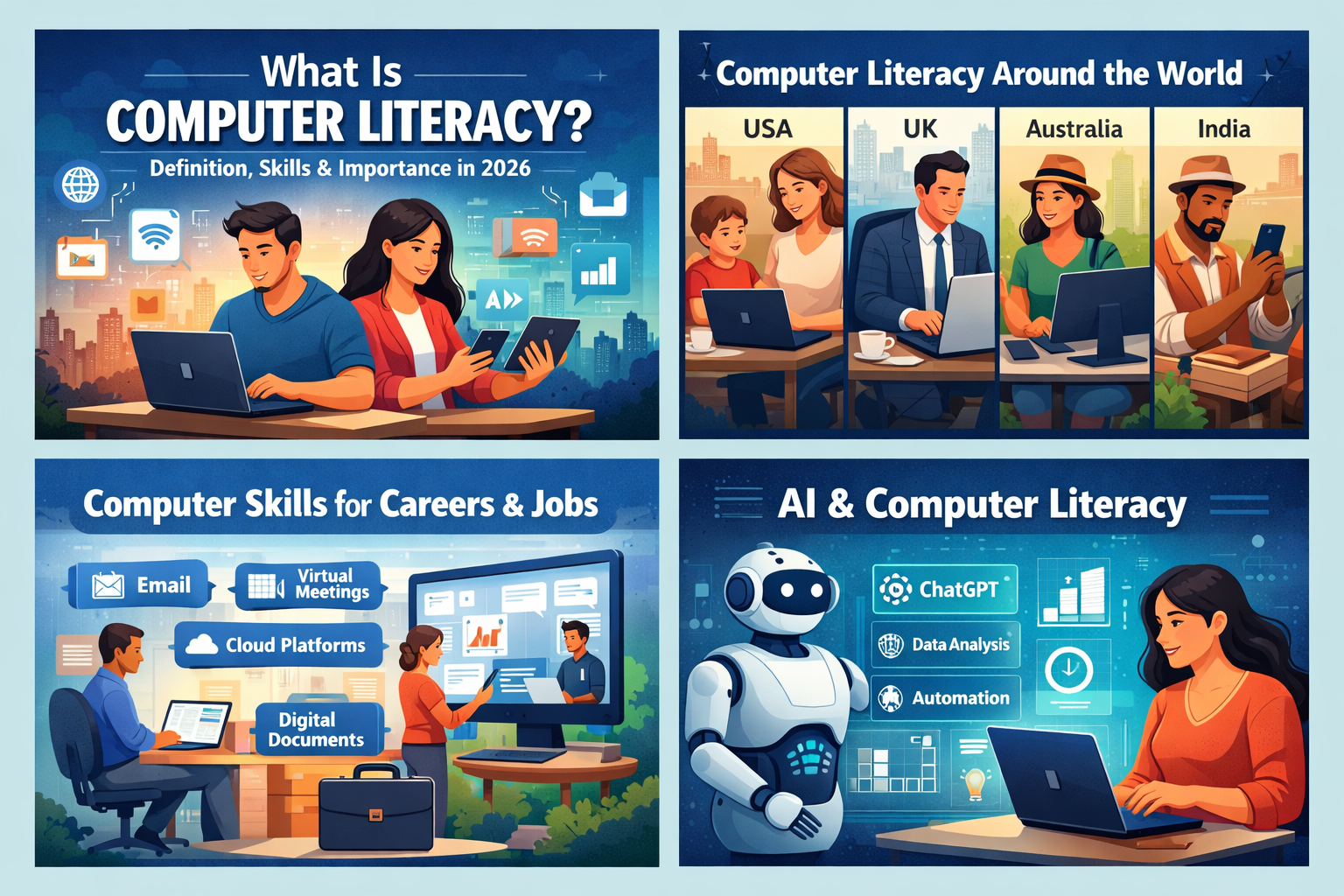
Computer literacy is the ability to use computers, internet technologies, and digital tools effectively to perform everyday tasks, solve problems, communicate, and achieve personal, educational, or business goals.
In simple words, when a person understands how to use technology – such as computers, smartphones, software applications, websites, email, and online services to complete real-life tasks independently or with guidance, that person is considered computer literate.
In 2026, literacy is no longer limited to reading and writing. Global organizations such as the International Telecommunication Union and UNESCO emphasize “meaningful connectivity.” This means true literacy today includes having the skills to use digital tools effectively – not just access to the internet.
What Computer Literacy Means in Daily Life
Computer literacy whether on a desktop, laptop, or smartphone – plays a important role in our daily life, from managing personal finances and communicating online to remote work, learning new skills, and running a business. Read More: Top 10 Uses of computer in our daily life
A parent in United State managing online banking, scheduling telehealth appointments, helping a child submit homework through Google Classroom, and filing taxes online is demonstrating computer literacy.
In the United Kingdom, a professional using remote collaboration tools like Microsoft Teams, applying for jobs through LinkedIn, and accessing NHS services online relies on digital competence daily.
In Australia, small business owners use online invoicing software, manage digital payments, and advertise through social media platforms.
In India, students attend online coaching classes, farmers check government schemes through portals, and small shopkeepers accept UPI payments and manage WhatsApp Business accounts.
In all these cases, the common factor is not device ownership – it is practical usage.
Computer literacy is the ability to function confidently in a technology-driven society.
If you’re just beginning, start with our complete guide to Online Basic Computer Courses – Learn Essential Computer Skills step by step.
Core Skills Included in Computer Literacy
Computer literacy includes a spectrum of skills that develop over time.
At the basic level, it includes operating devices, browsing safely, sending emails, managing files, using office applications, and understanding online risks such as phishing and scams.
At the intermediate level, it involves working with spreadsheets, managing cloud storage, participating in virtual meetings, using collaboration platforms, conducting online research efficiently, and understanding data privacy.
At the advanced level, it extends to data analysis, website management, digital marketing, automation tools, cybersecurity awareness, and even using AI systems effectively.
Many people assume they are computer literate because they use social media. However, true literacy involves structured understanding, safe usage, and problem-solving ability.
Computer Literacy vs Digital Literacy
Computer literacy and digital literacy are related but not identical. Computer literacy focuses primarily on operating hardware and software systems – using computers, applications, and technical tools.
Digital literacy is broader. According to UNESCO, digital literacy includes the ability to access, manage, evaluate, create, and communicate information safely using digital technologies.
In simple terms: Computer literacy teaches you how to use tools.
Digital literacy teaches you how to think, evaluate, and communicate responsibly within digital environments.
Computer literacy forms the foundation. Digital literacy builds on it.
A person may know how to use a spreadsheet (computer literacy), but evaluating whether an online article contains misinformation requires digital literacy.
In 2026, both are essential.
Why Computer Literacy Is Critically Important in 2026
As of late 2025, around 6 billion people – nearly 75% of the global population – are online, according to the International Telecommunication Union. However, approximately 2.2 billion people remain offline, mostly in low-income regions.
The issue is no longer just access. It is skills.
Even in high-income nations, there are gaps in digital problem-solving abilities between education levels. This means computer literacy is still developing globally.
Let’s understand its importance in different areas.
Impact on Career and Employment
Computer literacy has become the basic entry requirement for most jobs.
In the US, UK, and Australia, even entry-level positions expect employees to:
- Communicate through email
- Manage documents digitally
- Use cloud-based platforms
- Attend virtual meetings
- Collaborate using online tools
The World Economic Forum Future of Jobs Report 2025 highlights that expanded digital access and technological transformation will reshape business operations by 2030.
In India and other growing economies, digital platforms are opening remote job opportunities, freelancing, online teaching, and IT-enabled services. However, without computer literacy, individuals cannot access these opportunities.
Even roles that do not require advanced technical skills assume digital competence.
Today, computer literacy is not a special qualification – it is expected.
Impact on Business and Entrepreneurship
Modern businesses – whether in Sydney, London, New York, or Mumbai – depend heavily on digital systems.
A local bakery in Melbourne may use Instagram marketing and online ordering systems. A plumber in Manchester may generate leads through Google Business listings. A freelancer in Himachal Pradesh may serve international clients using remote collaboration tools.
Digital payments, online invoices, e-commerce platforms, customer relationship management tools, and AI-powered automation systems are no longer optional for businesses that want to grow.
A computer-literate entrepreneur understands how to leverage these tools – even if they outsource execution.
That understanding creates competitive advantage.
Impact on Education
Education systems across the US, UK, Australia, and India have integrated digital tools into learning environments.
Students now:
- Submit assignments online
- Attend virtual classes
- Use AI-assisted research tools
- Access global educational platforms
- Collaborate digitally
Without computer literacy, students fall behind – not because they lack intelligence, but because they lack access to digital systems.
Computer literacy ensures equal participation in modern education.
Read More: How has technology improved education?
Computer Literacy in the Age of Artificial Intelligence
The rise of AI has further increased the importance of computer literacy.
Between 2021 and 2026, demand for generative AI skills increased dramatically. However, many employers do not explicitly mention basic digital skills because they are assumed.
To use AI tools effectively, individuals must already understand:
- Online platforms
- Data input and output
- Digital workflows
- Information evaluation
AI does not replace computer literacy. It requires it. In fact, from now the AI era makes foundational digital competence even more critical. Here’s a practical breakdown of how AI tools like ChatGPT are changing everyday work. Top 3 highly productive uses of ChatGPT in Business
National Development and Social Impact
A nation’s progress is closely linked to the digital competence of its citizens. Governments across the world now treat digital skills as a core development priority.
In India, initiatives such as Digital India aim to transform the country into a digitally empowered society and knowledge economy. Programs under Pradhan Mantri Gramin Digital Saksharta Abhiyan (PMGDISHA) focus specifically on improving digital literacy in rural households. The Skill India mission also integrates digital competence into vocational and employment training programs.
Similarly, countries like the United States, the United Kingdom, and Australia invest heavily in national digital capability frameworks to prepare their workforce for technology-driven economies.
When individuals use technology ethically and productively:
- Innovation increases
- Transparency improves
- Access to public services expands
- Economic productivity grows
Digital governance systems, online banking infrastructure, e-health services, online tax filing, and direct benefit transfers all depend on citizens being able to use digital platforms confidently.
Countries with higher digital literacy rates show stronger workforce participation, better access to education, increased entrepreneurial activity, and improved public service delivery.
Computer literacy empowers individuals – and empowered individuals strengthen nations.
Who Is Not Computer Literate?
Owning a computer/smartphone/Insta account/AI does not make someone computer literate.
A person who:
- Avoids digital systems
- Cannot perform basic online tasks
- Falls victim to simple online scams
- Does not understand digital safety
Lacks practical computer literacy. True literacy requires awareness, understanding, and responsible use.
As established, computer literacy is no longer optional; it has become a foundational life skill.
Whether you live in Himachal, New York, London, Sydney the ability to use technology confidently, safely, and productively determines your access to education, employment, business growth, and informed participation in society.
In 2026 and beyond, computer literacy is not just about machines. It is about empowerment.
Frequently Asked Questions
What is computer literacy in simple terms?
Computer literacy means having the skills to use computers, mobile, the internet, and digital tools effectively and safely for daily life, work, and education.
Why is computer literacy important today?
Because almost every industry, education system, and government service now operates digitally. Without it, opportunities become limited.
Is computer literacy the same as digital literacy?
No. Computer literacy focuses on using systems and tools, while digital literacy includes evaluating information and communicating responsibly online.
Can someone be successful without computer literacy?
In today’s digital economy, long-term success without computer literacy is increasingly difficult because most systems rely on digital processes.